
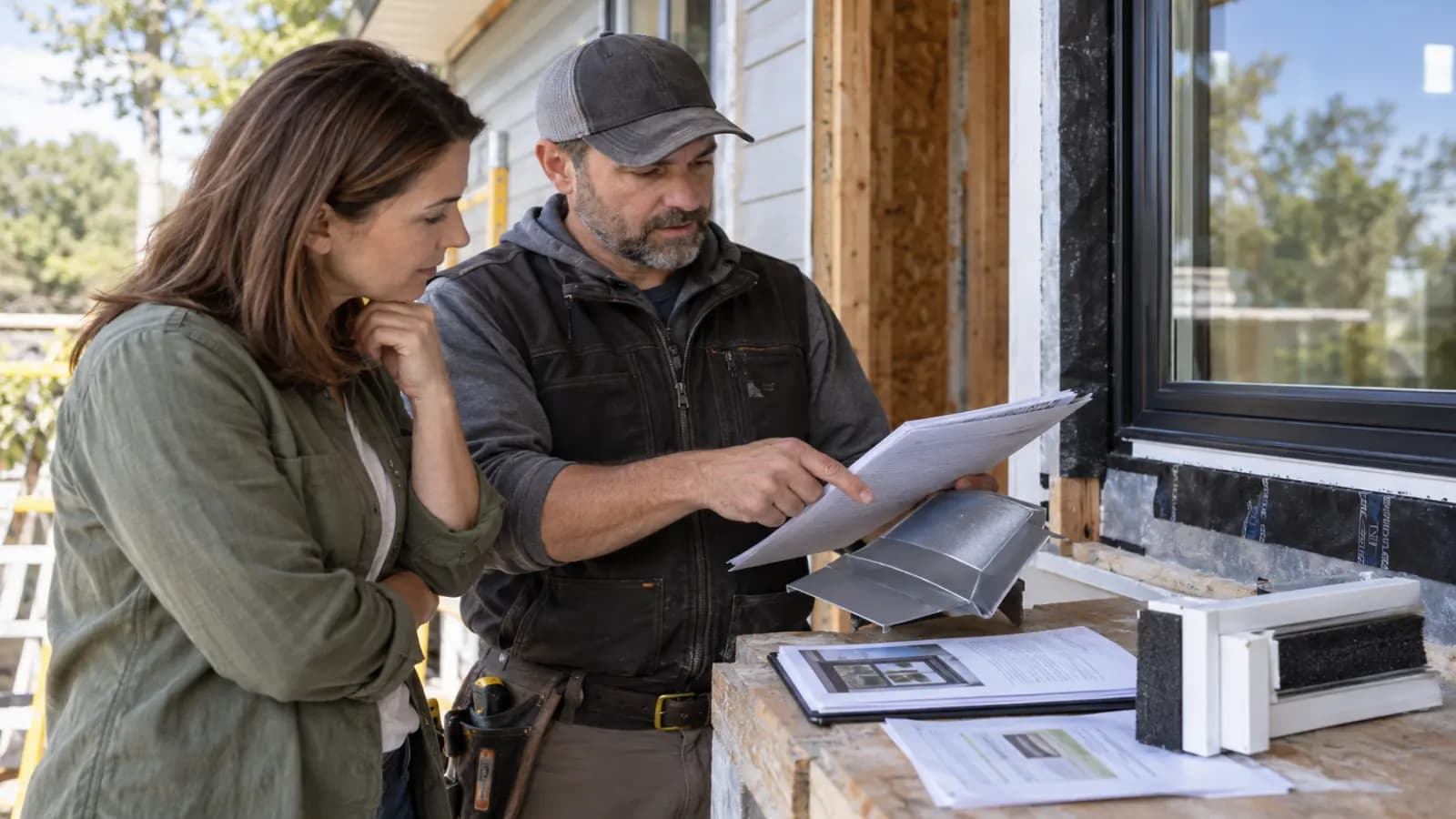
Compare installers by the exact opening, product, water-management detail, warranty responsibility, testing, change process, and closeout—not a lifetime headline.
Looking for verified window-installation specialists? Check availability in seconds.
Check ZIP code availabilityHire against an opening schedule—not a brand presentation
Create one ID for every opening and give the same schedule to each bidder. Record room, elevation, story and access, approximate size, existing operation and frame, insert or full-frame candidate, visible damage, leak history, desired operation, interior and exterior finish, and special concerns such as emergency escape, safety glazing, noise, historic character, wind exposure, or accessibility.
The proposal should return that schedule with the exact manufacturer, product line, configuration, dimensions, frame and finish, glass option, grids, screens, hardware, NFRC ratings, installation method, clear-opening effect, trim, and price for every ID. A whole-house total without opening-level detail makes substitutions, omissions, and warranty claims difficult to trace.
Separate salesperson, contracting entity, license holder, manufacturer, measuring party, installer, subcontractor, permit holder, and warranty provider. They may be different organizations. The contract must identify who is legally responsible for field measurement, ordering, delivery damage, installation, corrections, service, and final records.
Verify the business, crew, and coverage with primary sources
Check the contractor license or registration with the issuing state or local authority where one is required, including classification, status, expiration, complaints or discipline if published, and whether the named contracting entity matches the proposal. A manufacturer badge or trade membership is not a government license.
Request current general-liability and workers' compensation evidence appropriate to the project, then verify material questions with the insurer, agent, state system, or qualified adviser rather than treating a PDF as proof of every exposure. Ask who covers subcontractors, property damage, occupied-home work, elevated access, and completed operations. Insurance does not replace competent work or a written warranty.
Ask for recent projects with the same wall, cladding, window type, installation method, and exposure—not just a list of happy customers. Confirm who led those crews and who would lead yours. Review permits and inspection records where public, and ask references how the contractor handled protection, concealed damage, scheduling, punch items, and service after payment.
Require representative-opening investigation before final scope
A visual sales visit cannot reveal every concealed condition, but it should inspect representative and suspicious openings. Operate windows; examine sill, frame, stops, cladding, trim, sealant, drainage, wall staining, softness, corrosion, insect damage, and exterior interfaces. Record measurements and moisture observations with their limits. One dry surface reading does not clear a wall.
If all openings are priced as inserts, ask what evidence shows the retained frame and wall relationship are suitable. If all are priced full-frame, ask why each additional removal and finish scope is necessary. A mixed project can be correct. Define the condition that would change the method after removal and the cost and schedule process for that change.
Recurring leakage, extensive decay, displaced masonry, structural cracks, altered headers, or uncertain wall drainage can warrant a building-envelope professional, engineer, or other qualified specialist before bidding. Window installers should not be forced to conceal a larger wall problem inside an allowance.
Ask for a project-specific water-management detail
There is no single flashing sequence for every replacement. The correct detail depends on flanged or nonflanged product, insert or full-frame boundary, existing water-resistive barrier, siding, stucco, masonry, trim, sill geometry, exposure, and manufacturer instructions. FGIA's AAMA 2400 practice, for example, addresses mounting-flange windows in open stud-frame construction under defined exposure; its title alone shows why one standard cannot be pasted onto every retrofit.
For full-frame work, request sill, jamb, and head drawings or annotated manufacturer details showing removal boundary, substrate repair, sill pan or sill flashing and end treatment where specified, jamb and head flashing sequence, water-resistive-barrier integration, head flashing or drip detail, weeps and drainage, fasteners, shims, sealants and compatibility, exterior finish, interior air seal, and insulation.
For inserts, show how the retained sill and frame are inspected, how the unit is supported and fastened, how exterior stops or capping shed water, which old sealants are removed or renewed, how interior gaps are air-sealed, and how existing and new drainage paths remain open. “Caulk around it” is not a sufficient drawing for either method.
Do not turn rules of thumb into universal flashing defects
Water-management materials must be layered and connected so the chosen assembly drains as designed, but details vary. A sealant bead at a sill may be required, omitted, interrupted, or located behind a flange depending on the product and installation instruction. The right question is not “Do you always seal the bottom?” It is “Show the approved drainage path and every sealant boundary for this product and wall.”
Confirm flashing and sealant adhesion to actual substrates, primer requirements, minimum temperatures, surface preparation, roller pressure for membranes, laps, corners, fastener penetrations, UV exposure limits, and chemical compatibility. Self-adhered flashing can fail on dusty, wet, cold, deteriorated, or incompatible surfaces even when the sequence looks correct.
Require photographs at the exposed opening, repaired substrate, sill detail, set window, jamb and head integration, air seal, insulation, and before trim. Photos do not prove performance, but they preserve evidence that otherwise disappears. Identify who reviews and accepts deviations before concealment.
Separate product, glass, finish, hardware, and labor promises
Obtain the complete current warranties before signing, not a brochure summary. FTC guidance explains that written consumer-product warranties covered by federal law must provide specified information and be available before sale; service warranties and state-law rights can be treated differently. This guide cannot determine which law or remedy applies to your contract.
Create a warranty matrix by provider, covered component or work, start date, duration, full or limited designation where applicable, proration, transferability, registration, exclusions, remedy, labor, shipping, diagnostic charge, access equipment, finish restoration, water damage, consequential costs, response process, dispute process, and required maintenance. “Lifetime” has no useful meaning until the contract defines whose lifetime, what component, and what remedy.
Manufacturer coverage may address an IGU seal, frame, finish, or hardware but exclude removal, installation, freight, trim, paint, scaffold, or damage caused by installation or building movement. The installer warranty may cover workmanship but exclude product defects and surrounding-wall leaks. Require one written process for determining responsibility when each party initially blames the other.
Define a water-intrusion response before there is a leak
The labor warranty should state whether it covers leakage through the installed unit, perimeter, retained frame, flashing interface, and work-disturbed wall—and what it excludes above, below, or beside the opening. Ask who provides emergency protection, investigation, moisture mapping, destructive access, drying, microbial remediation, reconstruction, finish matching, and insurer coordination.
Specify notice method, emergency contact, response target, homeowner duties, access, documentation, and temporary mitigation. Avoid language that voids all coverage because another professional protected the house during an emergency. Legal enforceability varies, so material exclusions or dispute clauses deserve local legal review.
A leak investigation should distinguish product, installation, adjacent wall, roof, cladding, condensation, plumbing, and maintenance conditions. Define whether diagnostic water testing is included, who selects the protocol, how surrounding assemblies are isolated, who pays if the leak originates elsewhere, and how opened finishes are restored.
Plan testing and commissioning before installation starts
Agree on inspections at delivery, after rough-opening exposure, before flashing is concealed, after installation, and at final walkthrough. Not every residential project needs laboratory testing, but every project needs objective acceptance criteria. Product damage, wrong configuration, missing markings, frame distortion, drainage obstruction, and finish defects are easier to correct before trim and final payment.
Commission every operable window: open, close, lock, unlock, tilt or remove where designed, engage limit devices, and confirm screens and hardware. Check consistent reveals, contact and compression seals, sash retention, clear opening where required, weeps, glass and frame damage, safety labels, interior and exterior finishes, and cleanup. Do not force a unit or accept “it will loosen up” without manufacturer support.
If air or water testing is specified, name the standard or written procedure, sampling or openings, test pressure and duration where applicable, pretest conditions, allowable leakage, responsible tester, witness, failure diagnosis, repair, retest, and cost. An uncontrolled garden-hose demonstration can create misleading results or damage and is not a substitute for a defined protocol.
Make lead-safe and occupied-home protection contractual
EPA's Renovation, Repair and Painting rule generally covers paid window replacement in pre-1978 housing and child-occupied facilities, subject to scope and exceptions. Verify the renovation firm's EPA or authorized-state certification, identify the certified renovator, and include required education, containment, work practices, cleaning, cleaning verification, waste handling, and records. State and local requirements may add to the federal program.
For every home, define furniture and window-treatment removal, floor and landscaping protection, dust control, HVAC isolation, daily cleanup, interior and exterior exclusion zones, pets, bathroom access, weather limits, and communication. Identify asbestos or other hazardous-material assumptions before disturbing old sealants, siding, glazing, or wall materials.
The daily plan should state how many openings may be exposed at once, who monitors weather, how an opening is made secure and weather-resistant during breaks or overnight, and what happens after an unexpected storm, delayed delivery, damaged unit, or failed inspection. Speed is not a substitute for controlled exposure.
Use contract and payment controls that fit local law
FTC consumer guidance recommends multiple written estimates, a complete contract, contractor identity and license information, start and completion estimates, and all promises in writing. Deposit limits, cancellation rights, lien notices, progress-payment rules, retainage, and required contract language vary by state and transaction. Do not copy a universal one-third deposit rule.
Tie payments to objective milestones such as approved order, verified delivery of correct undamaged products, completed installation groups, passed required inspections, resolved punch work, and final documents. Do not pay the full contract in advance. Confirm ownership, storage, insurance, and refund terms for custom units if the contractor fails before installation.
Every change order should identify opening, discovered condition, evidence, added or deleted scope, materials, price, tax, allowance effect, schedule effect, warranty effect, and written authorization before work. Define emergency stabilization separately. For property-protection concerns, ask a local adviser about contractor bonds, liens, joint checks, and waivers appropriate to the jurisdiction.
Use a six-part installer comparison checklist
Score what is documented rather than how polished the presentation feels. An unanswered item is an unresolved cost or performance risk, not an automatic reason to reject a contractor.
Business identity, license or registration, insurance verification, crew and subcontractors, manufacturer relationship, permits, comparable references, and responsible project manager
Opening schedule, field measurement, exact product and NFRC ratings, operation and clear opening, safety or impact glazing, code review, order approval, substitutions, delivery, and storage
Insert or full-frame removal boundary, retained-component acceptance, rough-opening repairs, project-specific sill/jamb/head flashing, drainage, sealants, air seal, insulation, trim, siding, masonry, and finishes
Lead-safe and hazardous-material scope, occupied-home protection, weather plan, daily security, cleanup, disposal, access equipment, landscaping, furniture, and window treatments
Schedule, price by opening, allowances and unit prices, payment milestones, cancellation and lien documents, written changes, permits, inspections, testing, punch list, and final-payment conditions
Manufacturer, glass, frame, finish, hardware, installation, and water-intrusion warranty matrix; claim responsibility; service response; transfer; registration; labels; photos; maintenance; and closeout file
The bottom line
The best window-installer proposal makes hidden work reviewable. It identifies every opening and product, shows how the selected method connects water, drainage, air, insulation, and finishes, assigns product and installation failures, explains testing, protects occupants, controls changes and payments, and delivers a complete record. A lifetime headline cannot substitute for those details.
If you are comparing window installers, submit your ZIP code, home age, number and type of openings, insert or full-frame scope if known, cladding and interior finishes, leak or rot history, stories and access, and lead or code concerns to request a free match with independent local providers. Verify licenses where required, insurance, lead-safe certification when applicable, references, permits, written details, and complete warranties before hiring; there is no obligation to choose a matched provider.
Frequently asked questions
What warranty should a window installer provide?
Request a written workmanship warranty defining covered installation, water-intrusion scope, duration, start date, exclusions, response, investigation, repair, finish restoration, transfer, and dispute process. Compare it with separate manufacturer coverage for glass, frame, finish, and hardware, and define who decides responsibility when causes overlap.
What should proper window flashing include?
It should follow the exact window, installation method, wall, cladding, exposure, manufacturer instructions, and applicable project requirements. Ask for sill, jamb, and head details showing drainage, water-resistive-barrier integration, pan or sill treatment where specified, compatible flashing and sealants, fasteners, weeps, air sealing, insulation, and finish restoration.
Should a window installer seal the bottom flange?
There is no universal yes-or-no rule. Product and wall details may require a continuous, interrupted, differently located, or omitted sealant line to preserve the intended drainage path. Require the installer to show the approved manufacturer or project detail for that exact assembly and explain where water exits.
How much should I pay a window installer upfront?
Deposit limits and contract rules vary by state, and custom products complicate payment risk. Do not use a universal percentage. Check local law, avoid full prepayment, confirm ownership and storage of ordered units, and tie later payments to verifiable delivery, installation, inspections, punch completion, and closeout documents.
What should I inspect before final payment for new windows?
Verify every opening against the schedule; operate and lock each unit; inspect glass, frames, screens, hardware, reveals, drainage, markings, trim, finishes, and cleanup; complete specified air or water tests and required inspections; resolve punch work; and collect permits, labels, photos, warranties, registrations, invoices, and maintenance instructions.
General hiring and planning information, not legal, code, building-envelope, lead, or warranty advice. Requirements and consumer rights vary by project and jurisdiction. Verify credentials with issuing authorities and obtain professional or legal guidance when needed.
Sources and further reading
- AAMA 2400: Installation of Windows with a Mounting Flange — Fenestration and Glazing Industry Alliance
- Siding and Window Retrofit Case Study — U.S. Department of Energy Building America Solution Center
- Residential Product Certification — National Fenestration Rating Council
- Businessperson's Guide to Federal Warranty Law — Federal Trade Commission
- Warranties — Federal Trade Commission Consumer Advice
- How To Avoid a Home Improvement Scam — Federal Trade Commission
- Renovation, Repair and Painting Program: Contractors — U.S. Environmental Protection Agency
- Renovation, Repair and Painting Firm Certification — U.S. Environmental Protection Agency
This guide was researched and reviewed by the GetLocalExperts Editorial Team against primary regulatory benchmarks, state contractor licensing board standards, and FTC consumer protection guidelines.