A safe, documented response to leaks, sewage, and flooding—plus the evidence needed to decide whether flooring and subfloor can be cleaned, dried, repaired, or replaced.
Looking for verified flooring specialists? Check availability in seconds.
Check ZIP code availabilityStart with danger—not the flooring
Do not enter a structurally damaged building, a room with a gas odor, or standing water that may contact energized wiring, outlets, appliances, cords, or equipment. CDC says that if the main power cannot be reached from a dry location, call an electrician; never switch power or use an electrical device while standing in water. If gas is suspected, leave without operating lights or anything that could spark and contact the gas utility or emergency authorities from outside.
Floodwater can contain sewage, agricultural or industrial contaminants, sharp objects, and displaced animals. A sewage backup is also contaminated even when the water looks clear. Keep children, pregnant people, older adults, and people with asthma, chronic breathing conditions, or weakened immune systems away from flood and mold cleanup. Follow evacuation, reentry, boil-water, and protective-equipment directions from local officials.
A wet floor is sometimes evidence of a larger emergency: a compromised ceiling, foundation movement, overloaded wet drywall, damaged electrical service, fuel leak, or rising exterior water. Call emergency services for immediate danger. Use qualified electrical, gas, structural, plumbing, water-mitigation, or environmental help when the hazard exceeds safe homeowner work.
Stop the source without creating another hazard
If it is safe, stop a supply leak at an accessible fixture shutoff or the home's main water valve. Do not enter a crawlspace, flooded basement, or damaged utility area to reach a valve. For roof, groundwater, sewer, appliance, fire-suppression, or shared-building water, contact the responsible emergency, utility, property-management, plumbing, roofing, or restoration service.
Record when the water was discovered, when the source stopped, and what caused it if known. Preserve failed hoses, valves, appliance parts, and plumber findings when safe; do not discard potential evidence until the insurer or responsible party gives direction. Correcting the source and drying the assembly are separate jobs—one does not prove the other is complete.
Document first, then begin reasonable damage control
Contact the insurer or agent promptly and follow the policy's reporting instructions. Photograph and video the source, water extent, room overview, flooring edges and seams, baseboards, walls, contents, appliance connections, visible contamination, and meter displays. Make a room-by-room inventory with product information, approximate age, receipts or prior photos when available, and serial numbers for affected equipment.
Do not delay urgent safety measures merely to wait for an adjuster. Keep damaged property when safe and practical, label samples removed to access wet assemblies, and ask before disposal unless officials require immediate removal. Save invoices, equipment logs, temporary-repair costs, hotel or additional-living-expense records, contractor reports, test results, and every claim communication.
Coverage is policy- and cause-specific. NAIC consumer guidance says water damage from household plumbing or a roof leak is typically covered, while groundwater, runoff, snowmelt, and other flood damage generally require separate flood coverage. That is general guidance, not a decision on your loss; the insurer must apply your policy, endorsements, exclusions, deductibles, duties, and facts.
Classify the water source before deciding what can stay
A newly released potable-water supply leak presents a different cleanup problem from a toilet overflow containing waste, sewer backup, river flood, storm surge, or water that traveled through soil and building cavities. Water can also become more contaminated through time and contact with flooring, adhesives, insulation, animal waste, chemicals, or microbial growth.
Do not use appearance, smell, or a casual “clean water” label as proof. Document the source, path, duration, affected materials, temperature, and any chemical or biological concern. A qualified remediator should establish containment, removal, cleaning, and drying scope for sewage, floodwater, extensive growth, HVAC involvement, vulnerable occupants, or uncertain contamination.
EPA recommends cleaning and drying the home and belongings within 24–48 hours if possible and assuming mold growth when a flooded home could not be dried in that period. Treat that window as an urgency target, not a warranty: materials may fail sooner, and a floor is not automatically clean, dry, or salvageable because extraction began before hour 48.
Remove water and control humidity only when the area is safe
Once electrical and structural conditions are cleared, professionals may use extraction, dehumidification, controlled airflow, heat where appropriate, and selective removal to expose wet layers. CDC says wet/dry vacuums and other powered equipment should be used only when an electrician has determined power is safe. Never connect a portable generator to household wiring without approved equipment, and operate fuel-powered generators outdoors at least 20 feet from doors, windows, and vents.
Open doors and windows when outdoor conditions help and it is safe. EPA advises ventilation, fans, and dehumidifiers during cleanup, but says not to use fans when visible mold is already present because they can spread it. CDC recommends directing fans outdoors during flood drying. Do not turn on a flooded or contaminated HVAC system until an experienced professional has evaluated and cleaned it.
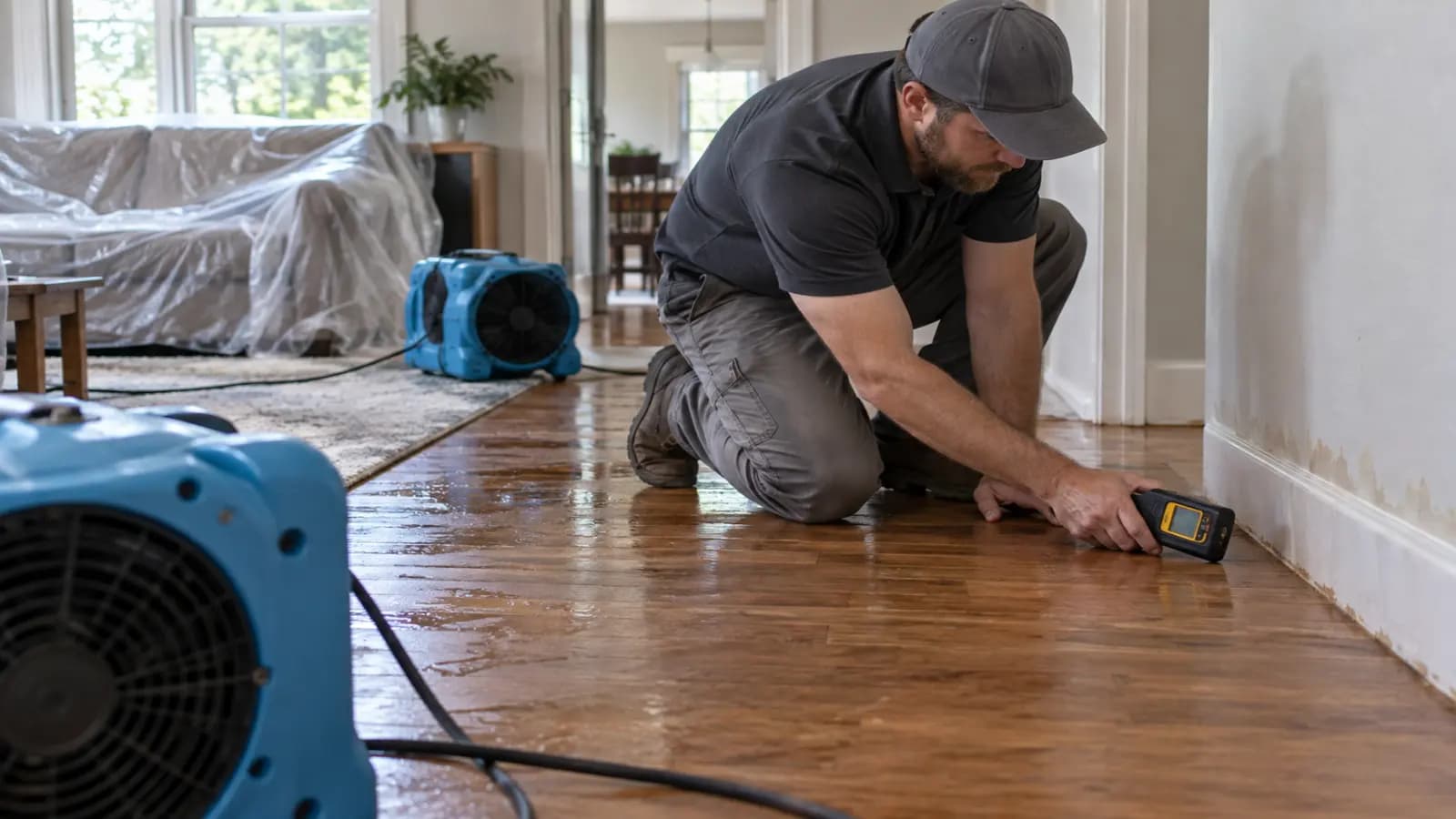
Drying equipment needs a defined layout, safe power supply, maintenance, and progress checks. More heat or airflow is not automatically better for wood finishes, adhesives, contents, or microbial containment. Record equipment type, placement, operating hours, indoor temperature and relative humidity, and interruptions such as power loss.
Judge salvage as a complete floor assembly
A finish surface can look normal while water remains in pad, underlayment, adhesive, plywood, oriented strand board, sleepers, wall plates, cabinets, or the ceiling below. Determine how water entered, whether it moved under partitions or built-ins, and how each layer can be inspected, cleaned, and dried. Surface readings alone do not clear the assembly.
A defensible salvage decision answers five questions: Was the water suitable for cleaning the material? Can every affected side and layer be accessed? Can the material be cleaned without damaging it? Can it reach an appropriate dry condition before deterioration continues? Will the flooring and installation system still meet manufacturer, appearance, dimensional, structural, adhesion, and warranty requirements? If any answer is no, removal may be necessary.
Before destructive access, check for hazards. Older flooring, backing, or adhesive may contain asbestos; pre-1978 painted baseboards or walls may require lead-safe practices when covered renovation work disturbs paint. Do not sand, grind, cut, or demolish suspect material until appropriately evaluated and handled under applicable federal, state, and local requirements.
What water exposure means for common flooring types
These are assessment paths, not guarantees. Source, duration, assembly, product instructions, and documented condition control the outcome.
Porous materials and contaminated water need a stricter decision
EPA says absorbent building contents such as paper, cloth, wood, and similar porous materials wet for 48 hours or more may need disposal because they can remain a mold source. CDC recommends discarding drywall and insulation contaminated with sewage or floodwater and items that cannot be cleaned or dried quickly. Local disaster and waste rules govern handling and disposal.
Do not reduce that guidance to “all carpet always goes” or “tile always stays.” Clean-water exposure, sewage, outdoor floodwater, visible growth, inaccessible layers, occupant vulnerability, and product construction lead to different decisions. Cleaning a hard surface does not decontaminate absorbent material beneath it.
At minimum, EPA flood guidance identifies protective gloves, an N95 respirator, and goggles without holes for mold cleanup, with additional protective clothing and boots. Respirators must be selected and worn correctly and do not control electrical, chemical, structural, or confined-space risks. Professional remediation may be the safer option.
Verify drying with a map and trend—not one meter number
A moisture meter produces a reading influenced by instrument type, scale, material, density, temperature, depth, metal, salts, surface condition, and operator technique. It does not directly identify mold, contamination, or hidden water everywhere. Ask the professional to explain the instruments, reference materials, measurement locations, limits, and interpretation.
Create a moisture map covering flooring, substrate, base plates, lower walls, cabinetry, adjacent rooms, and the level below where relevant. Use consistent labeled locations and compare trends with unaffected reference areas or other justified drying criteria. Add ambient temperature and relative humidity, equipment changes, demolition milestones, and photographs.
A project is not complete merely because exposed surfaces feel dry or one reading falls. Closeout should document that the source was corrected; contaminated material was removed or cleaned; affected assemblies met defined drying goals; no unresolved odor, visible growth, dimensional damage, or unsafe condition remains; and finish repairs follow product and trade requirements.
Do not sand a wet wood floor into a permanent defect
Wood flooring can cup when one face is wetter than the other. Its appearance may change during drying, and premature sanding can remove raised edges before moisture and dimensions stabilize. Later movement can reveal an opposite contour, gaps, or insufficient wear layer. Do not rely on a fixed two-week or four-week wait; the assembly, species, construction, finish, environment, drying method, and readings matter.
Ask a qualified wood-floor professional to document board and subfloor moisture, affected and reference readings, width and distortion trends, fastening or adhesive condition, finish damage, remaining wear layer, and manufacturer guidance. The decision may be continued observation, board replacement, repair, sanding and refinishing, or full replacement. Obtain insurer approval where required before permanent repair.
Build a written mitigation and repair scope
Before authorizing work, align the insurer, mitigation contractor, environmental consultant where needed, flooring contractor, and relevant trades on what is emergency mitigation versus permanent repair. Ask who controls contents, containment, testing, demolition, drying, cleaning, disposal, antimicrobial products, HVAC, substrate correction, flooring replacement, trim, paint, appliances, permits, and final verification.
Cause and source-control record, affected-room diagram, water path, contamination assumptions, safety hazards, and access restrictions
Pre-work photos, contents inventory, material samples where appropriate, asbestos or lead evaluation, and insurer authorization requirements
Removal boundaries by material and layer, protection and containment, disposal route, cleaning method, and responsibility for hidden conditions
Drying equipment plan, safe power, monitoring frequency, moisture map, reference areas, ambient logs, and written completion criteria
Repair specifications for substrate, flooring, pattern continuity, matching limitations, baseboard, paint, cabinets, doors, appliances, transitions, and rooms below
Itemized pricing, allowances, change-order approval, schedule, permits, credentials, insurance, labor and material warranties, punch list, and final report
The bottom line
Whether a water-damaged floor can be saved is not decided by finish type or a stopwatch alone. First make the building safe, stop and classify the source, document the loss, expose the complete affected assembly where necessary, clean or remove materials according to contamination and porosity, and verify drying through a recorded measurement plan. Only then decide whether the finish still meets product, performance, appearance, and warranty requirements.
If your floor has taken on water, submit your ZIP code, water source, discovery time, affected rooms and levels, flooring type, visible damage, known electrical or contamination concerns, and insurer status to request a free match with independent local flooring or restoration providers. For immediate hazards, use emergency services and appropriately qualified trades first. Verify licenses where required, insurance, remediation experience, written scope, and claim procedures before hiring; there is no obligation to choose a matched provider.
Frequently asked questions
Can water-damaged flooring be saved?
Sometimes. The decision depends on the water source and contamination, exposure duration, flooring and underlying layers, access for cleaning and drying, documented moisture trends, dimensional or bond damage, manufacturer requirements, and occupant risk. A dry-looking surface alone is not enough evidence.
How quickly does flooring need to dry after a leak?
EPA recommends cleaning and drying a flooded home and belongings within 24–48 hours if possible and assuming mold growth when that was not achieved. This is an urgency target, not a guarantee. Start safe mitigation promptly, then use documented criteria—not elapsed time alone—to verify the entire assembly is dry.
Does vinyl plank flooring have to be removed after water gets underneath it?
Not automatically, but its water-resistant face does not make the complete floor waterproof. The water source, contamination, underlayment, substrate, perimeter and wall cavities, locking edges, adhesive where used, and ability to clean and verify drying determine whether selective lifting, replacement, or another access method is appropriate.
Should carpet and padding be replaced after a water leak?
Carpet exposed to a limited, recent potable-water leak may sometimes be professionally cleaned and dried, but carpet, backing, pad, tack strip, subfloor, seams, odor, and contamination all require evaluation. CDC advises discarding carpeting and padding that cannot be cleaned and dried quickly; sewage or floodwater calls for a stricter professional assessment.
Does homeowners insurance cover water-damaged flooring?
Coverage depends on the policy and cause. NAIC says household plumbing or roof-leak water damage is typically covered, while groundwater, runoff, snowmelt, and flood damage generally require separate flood coverage. Report promptly, prevent further damage when safe, document everything, preserve evidence, and obtain the insurer's decision under your actual policy.
Emergency planning information, not remediation, medical, electrical, structural, environmental, or insurance advice. Do not enter an unsafe building or touch electrical equipment while wet or standing in water. Follow emergency officials, your utility, insurer, product instructions, and appropriately qualified local professionals.
Sources and further reading
- Flooded Homes Cleanup Guidance — U.S. Environmental Protection Agency
- Text Version of the Flooded Home — U.S. Environmental Protection Agency
- Dealing with Debris and Damaged Buildings — U.S. Environmental Protection Agency
- Water Damage Table: Cleanup and Mold Prevention — U.S. Environmental Protection Agency
- Safety Guidelines: Reentering Your Flooded Home — Centers for Disease Control and Prevention
- Guidelines for Cleaning Safely After a Disaster — Centers for Disease Control and Prevention
- Urban Flooding: Guidance for Homeowners and Renters — Federal Emergency Management Agency
- Consumer Homeowners Insurance — National Association of Insurance Commissioners
This guide was researched and reviewed by the GetLocalExperts Editorial Team against primary regulatory benchmarks, state contractor licensing board standards, and FTC consumer protection guidelines.