Compare localized treatment, liquid soil treatment, bait systems, wood treatment, and fumigation without mistaking different scopes for the same job.
Looking for verified pest-control specialists? Check availability in seconds.
Check ZIP code availabilityTermite treatment cost at a glance
Many professional termite projects fall around $1,200 to $3,500, but that number is useful only as a planning range. A limited treatment may start near $250 to $800; liquid soil treatment often runs about $800 to $2,500; an initial bait-system installation may run about $1,500 to $3,500; and whole-structure fumigation can reach roughly $4,000 to $8,000 or more. Inspection may be complimentary with treatment or billed separately, often around $75 to $200.
Those ranges are not interchangeable menu prices. Species, active locations, home perimeter or volume, slab and foundation design, crawlspace access, drilling, product, monitoring, local labor, and warranty all change the total. Structural repair, moisture correction, hotel stays, food preparation, landscaping restoration, and engineering are commonly outside the treatment price unless the proposal says otherwise.
Use the figures to set a budget and identify unusually incomplete quotes—not to choose a treatment before inspection. The least expensive proposal can be appropriate when the infestation is truly accessible and localized; it can also be a different, narrower scope that leaves the principal route of entry untreated.
Identify the termite before comparing treatments
Subterranean termites live primarily in soil colonies and enter structures while foraging. Common professional approaches include a labeled liquid treatment in soil, a monitored bait system, direct treatment in defined locations, or a combination. Fumigating the house does not control a subterranean colony concentrated below ground, so a quote that treats subterranean and drywood termites as the same problem needs clarification.
Drywood termites live within sound, relatively dry wood without continuous soil contact. When every active area can be found and reached, a licensed professional may propose localized injection, heat, or another labeled method. When infestations are widespread, hidden, or difficult to delimit, whole-structure fumigation or heat may be considered. Dampwood termites are strongly associated with wet or decaying wood, making moisture and damaged-wood correction central to the plan.
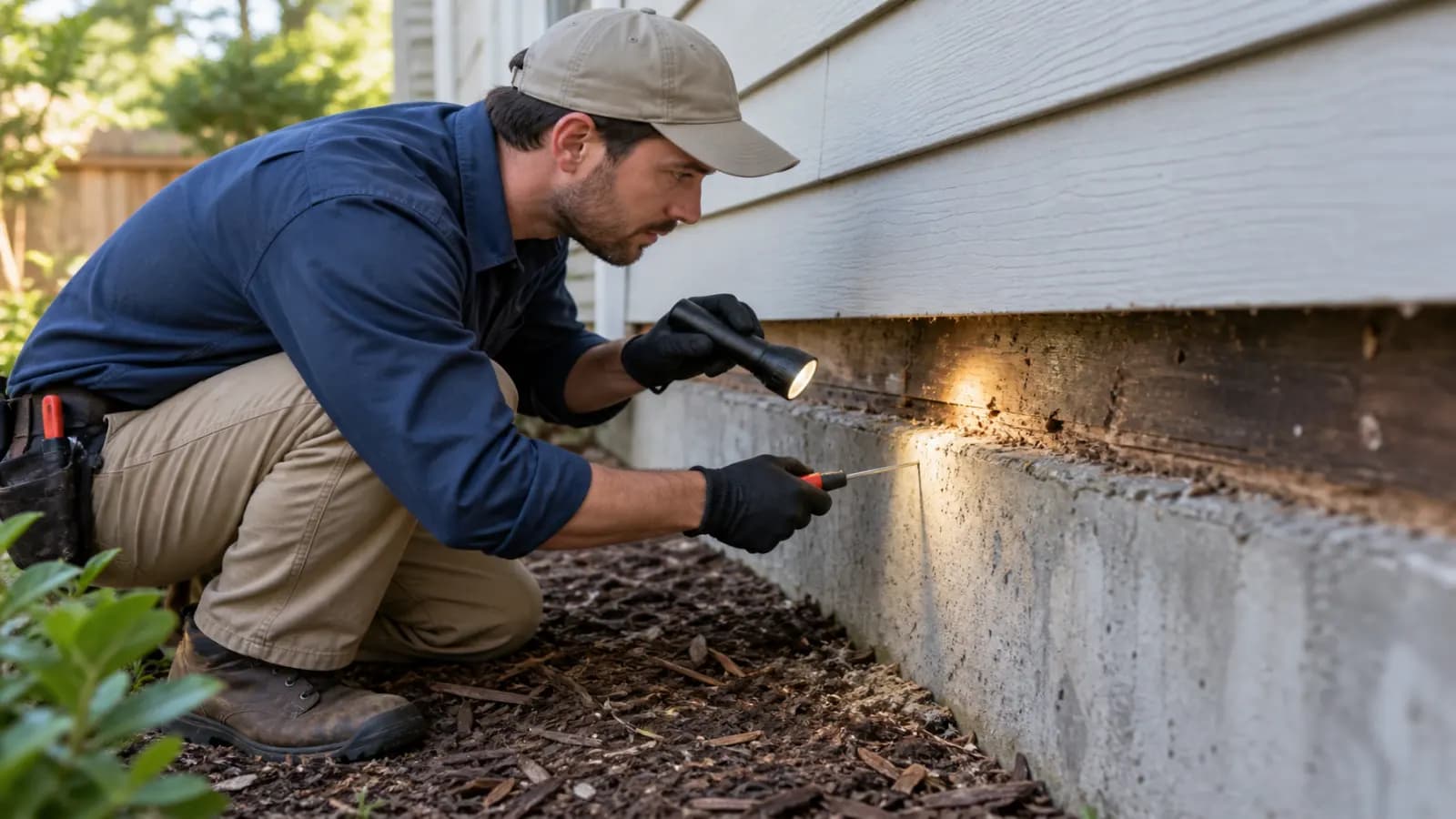
Mud tubes, swarmers, discarded wings, pellet-like frass, hollow-sounding wood, and blistered surfaces are reasons to request an inspection, not a reliable do-it-yourself species diagnosis. Save samples or clear photographs and avoid spraying, breaking all tubes, opening walls, or discarding damaged wood before the inspector documents the evidence.
What each termite treatment price may include
Ask bidders to name the method and measured scope. A single total labeled “termite treatment” cannot show whether two companies are solving the same problem.
Spot treatment versus a broader plan
“Spot treatment” describes limited placement, not proof that the termite problem is limited. It is most defensible when the professional identifies the termite, maps a small active area, explains how hidden activity was evaluated, can reach the target, and provides a follow-up plan. Drywood localized methods depend heavily on accurate detection; inaccessible or multiple areas increase the chance that untreated insects remain.
For subterranean termites, a few visible tubes may be only part of a larger foraging pattern. A proposal might therefore use a continuous or defined liquid soil treatment, monitored bait stations, or targeted work combined with broader control. A liquid “barrier” is a treated zone created according to the product label—not a visible, permanent wall that makes future inspection unnecessary. Soil movement, additions, landscaping, plumbing work, and label-specific conditions can affect it.
Bait is not simply a cheaper liquid substitute. Stations depend on termites locating and feeding on bait and require inspections and servicing on the stated schedule. Ask how activity is assessed, what happens when a station is disturbed, who owns the stations, and what protection remains if you stop paying renewal fees.
What a useful termite inspection documents
A good report separates current evidence, old or inconclusive damage, conducive conditions, and inaccessible areas. It should identify the suspected species or termite group, show activity and damage on a diagram, describe the foundation and construction features that affect treatment, and state whether destructive inspection or another specialist is recommended.
Expect notes about wood-to-soil contact, plumbing or roof leaks, drainage, crawlspace moisture, earth-filled porches, slab joints, additions, foam insulation, wells, cisterns, ducts, hardscape, and areas blocked by finishes or stored belongings. The inspector should explain what could not be seen; “no visible activity” in a concealed area is not the same as proof that termites are absent.
Treatment and structural repair are different scopes. If joists, beams, posts, sill plates, subfloor, roof framing, or other load-bearing components may be compromised, obtain an appropriate contractor or engineer assessment before removing or covering evidence. A termiticide kills or controls the target pest according to its label; it does not restore lost wood capacity.
How to compare termite quotes line by line
Give each company the same inspection access and ask for a written proposal. If recommendations differ, ask each inspector to connect the method to the species, evidence, construction, and untreated risk instead of voting by price.
Legal company name, state-required pest-control license, responsible certified applicator, and insurance information
Termite type, active evidence, damage, conducive conditions, inspection diagram, and all inaccessible areas
Product and active ingredient, EPA registration number, label, application locations, quantities or measured scope, and method
Trenching, drilling, rodding, stations, wood injection, fumigation, heat, preparation, patching, cleanup, and restoration included
Initial price, inspection fee, taxes, annual monitoring or renewal, optional work, and conditions that create a change order
Reinspection schedule, success criteria, callbacks, retreatment terms, repair coverage, exclusions, cap, deductible, and transfer rules
Moisture, drainage, wood contact, damaged framing, inaccessible areas, and other corrections assigned to the owner
Read the warranty as a separate product
A retreatment agreement generally promises additional treatment when covered termites are found during the term. A repair or damage agreement may add payment for defined new damage, but names do not establish coverage. Read the actual contract for limits, deductibles, proof requirements, waiting periods, excluded species, preexisting damage, inaccessible areas, moisture or structural-change exclusions, and whether the company chooses the repair contractor.
Record the inspection frequency, renewal price and increase rules, owner duties, transfer procedure, cancellation terms, and consequences of a missed appointment or payment. For bait systems, confirm whether stations belong to you or the provider and whether removal ends protection. Ask what happens after landscaping, a new patio, foundation work, a plumbing trench, an addition, or disturbed treated soil.
The EPA recommends asking whether a company is responsible for structural damage if termite treatment fails. That is a question to resolve in writing, not an assumption to make from the word “warranty.” Keep inspection reports, diagrams, labels, contracts, renewal receipts, repair photographs, and clearance documents together.
Pesticide, drilling, and occupancy safety
Structural termite treatment is not a good trial-and-error DIY project. EPA says termite products intended to protect a structure must be registered for that use and applied according to the label; many proven techniques require trained professional application. Verify the business and applicator with the state pesticide regulator and request the product label before work.
Tell the provider about children, pregnancy concerns, pets, aquariums, gardens, wells, cisterns, drains, HVAC pathways, allergies, and anyone who may have difficulty leaving. Ask for written preparation, ventilation, cleanup, spill, and reentry instructions. Reentry time varies by product and method—the applicator’s casual estimate does not override the label or formal clearance requirements.
Drilling and trenching also create property risks. Mark utilities and private lines as appropriate, identify radiant heat or post-tensioned slabs, and agree on holes, finishes, irrigation, waterproofing, and patching. Fumigation requires detailed food, medicine, plant, pet, gas, security, vacancy, aeration, and clearance coordination; follow the licensed fumigator’s written directions exactly.
A practical quote comparison
Suppose one inspector quotes $600 to inject an accessible drywood gallery, a second quotes $2,100 for subterranean bait stations, and a third quotes $6,000 for whole-structure drywood fumigation. Those are not three bids for one specification. Before choosing, resolve the identification: what evidence supports drywood or subterranean termites, where was activity found, which areas were inaccessible, and why does each method fit that evidence?
If the finding is one reachable drywood area and a careful inspection found no other signs, localized work with documented follow-up may be reasonable. If several drywood areas or concealed activity are likely, broader treatment deserves consideration. If the insects are subterranean, compare the liquid or bait plan—not fumigation—as well as inspection frequency, foundation coverage, ongoing fees, and conditions excluded. A third independent inspection is often more useful than negotiating three incompatible prices.
Reduce the conditions that help termites return
Repair plumbing, roof, gutter, grading, and drainage problems that keep wood or soil wet. Correct avoidable wood-to-soil contact, remove cellulose debris from crawlspaces, store firewood away from the structure, maintain access for inspection, and avoid hiding the foundation edge behind dense planting or finishes. Ask a qualified professional how local construction and climate change those priorities.
Do not disturb treated soil or bait stations without coordinating with the termite company. Tell the provider before installing patios, landscaping, irrigation, additions, insulation, or utility trenches. Prevention lowers pressure and preserves visibility, but it does not replace scheduled inspections or a treatment recommended for confirmed activity.
The bottom line
The right termite treatment cost is the price of a method matched to the termite, active locations, access, and construction—not the smallest number on a generic menu. Insist on a documented inspection, measured treatment scope, product and safety information, continuing-service costs, repair boundaries, and the complete warranty before comparing totals.
If you have termite evidence, submit your ZIP code and inspection details to request a free match with independent local pest-control providers. Verify licensing with your state regulator, obtain multiple written inspections when practical, and choose only after the proposed treatment and exclusions make sense; there is no obligation to hire a matched provider.
Frequently asked questions
How much does termite treatment cost?
Many professional liquid or bait projects fall around $1,200 to $3,500, while limited work may start around $250 to $800 and whole-structure fumigation may reach roughly $4,000 to $8,000 or more. Species, home dimensions, foundation, access, region, preparation, monitoring, and warranty determine the actual quote. Structural repairs are usually separate.
Is spot treatment enough for termites?
It can be appropriate for a correctly identified, accessible, localized infestation with a credible inspection and follow-up plan. It is less persuasive when activity is widespread, concealed, inaccessible, or associated with subterranean foraging routes. Ask the professional to document why untreated areas are unlikely to remain active.
Are liquid termite treatment and bait stations equally effective?
Both can be valid approaches when the product, site, termite, installation, and follow-up fit. Liquid treatment creates a labeled treated zone; bait relies on termites finding and feeding at monitored stations. Compare construction constraints, timing, inspection and renewal requirements, disturbance risk, and contract coverage rather than asking which method wins universally.
Does fumigation prevent termites from coming back?
Whole-structure fumigation can control drywood infestations throughout a properly treated structure at the time of treatment, including hidden locations, but it does not create permanent protection against later reinfestation. It also does not control subterranean colonies below ground. Continued inspection and prevention remain important.
How soon can my family return after termite treatment?
There is no universal waiting period. It depends on the product, application, label, and—during fumigation—the required aeration and clearance process. Obtain written preparation and reentry instructions from the licensed provider and do not return early based on a generic timetable.
Cost ranges here are general research estimates compiled from national and regional data. They are not quotes, offers or price guarantees — only a licensed provider who has seen the job can price it. GetLocalExperts is a free matching service and does not perform home services.
Sources and further reading
- Termites: How to Identify and Control Them — U.S. Environmental Protection Agency
- Tips for Selecting a Pest Control Service — U.S. Environmental Protection Agency
- Citizen's Guide to Pest Control and Pesticide Safety — U.S. Environmental Protection Agency
- Drywood Termites — University of California Statewide IPM Program
- Subterranean and Other Termites — University of California Statewide IPM Program
- Termite Treatment Cost — Pest Control Pricing
This guide was researched and reviewed by the GetLocalExperts Editorial Team against primary regulatory benchmarks, state contractor licensing board standards, and FTC consumer protection guidelines.