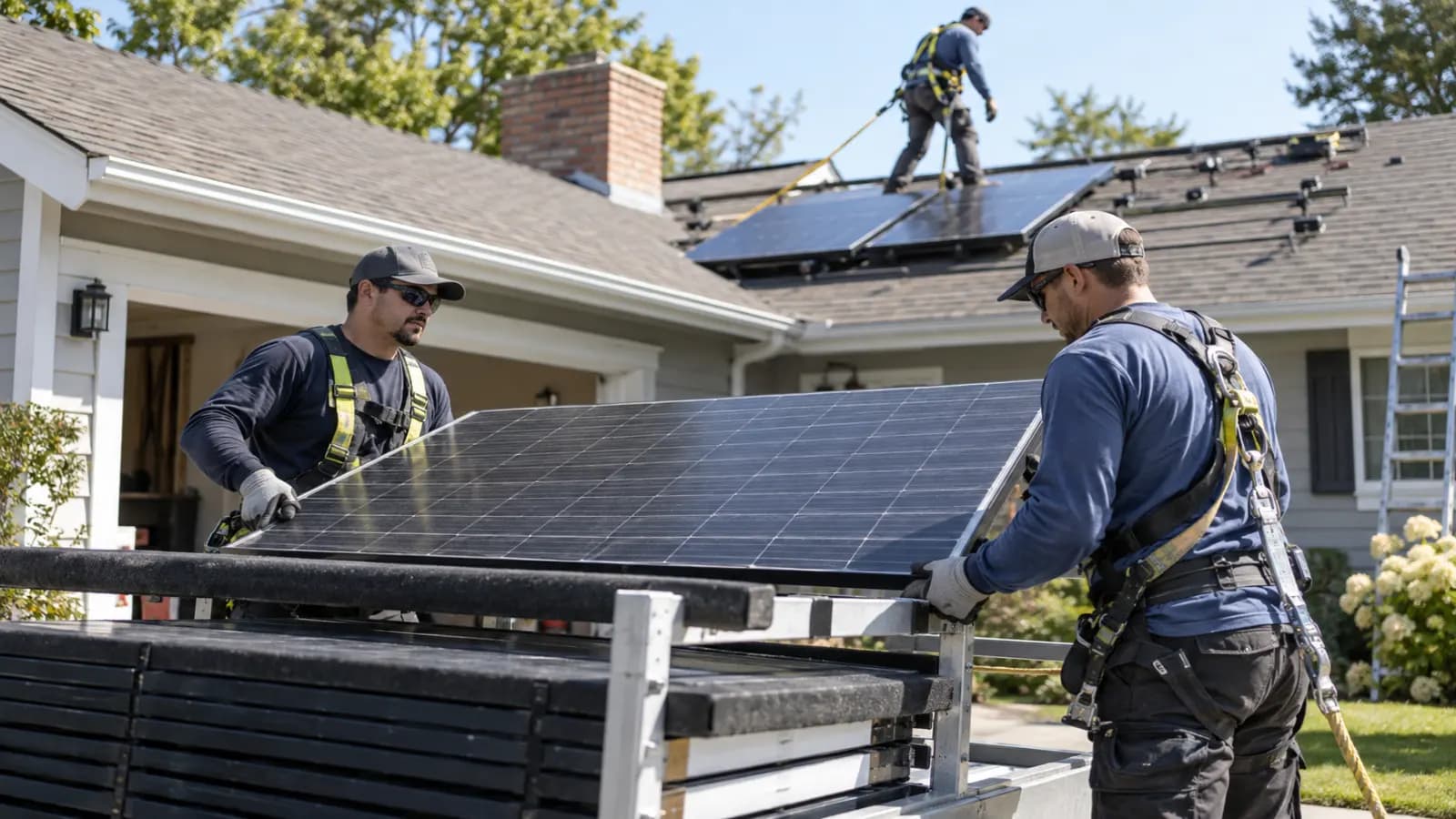
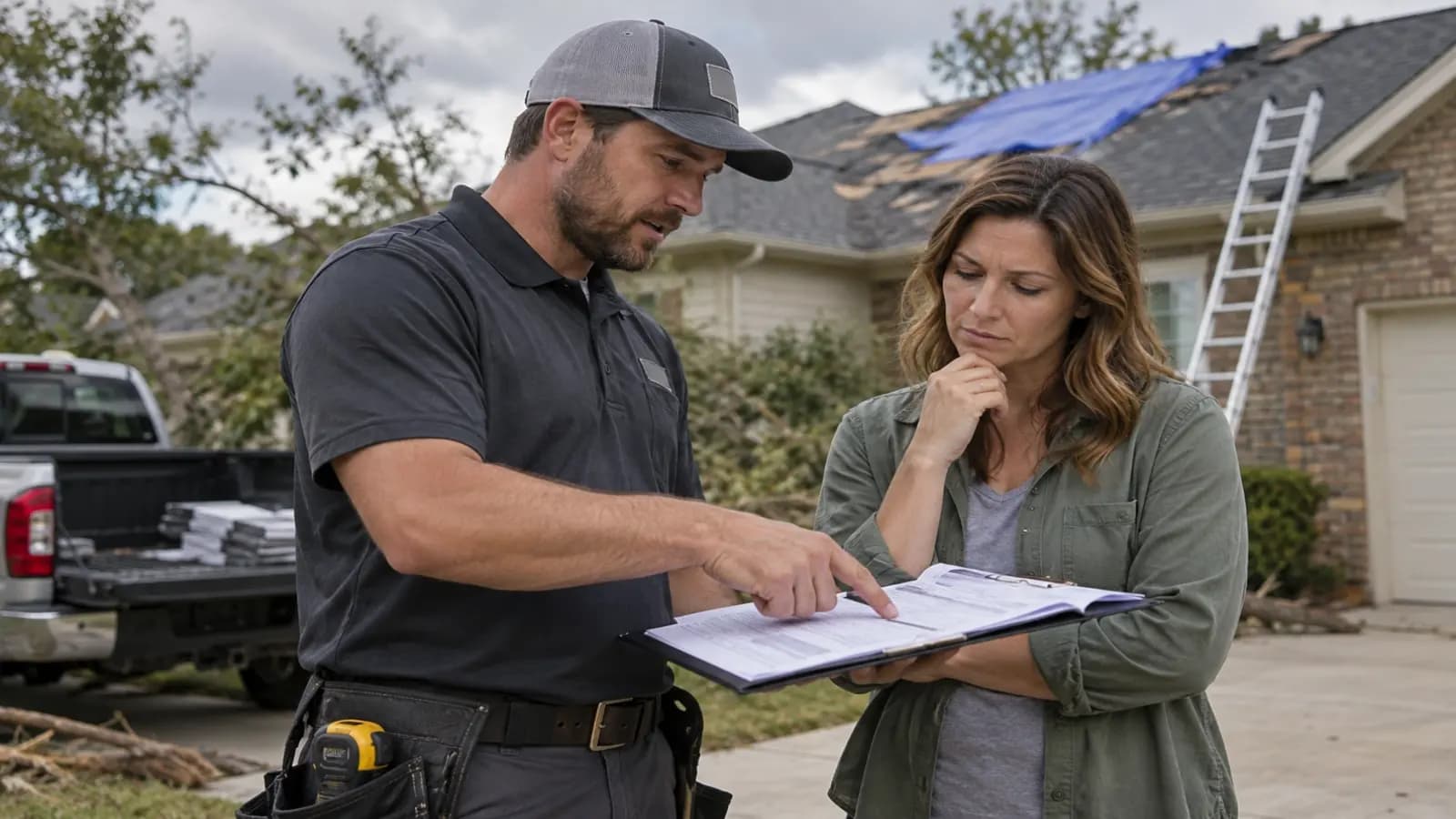
A post-storm roofer is not untrustworthy merely because the crew traveled. Use these checks to find out who is accountable before signing, paying, or assigning claim rights.
Looking for verified roofing specialists? Check availability in seconds.
Check ZIP code availabilityWhat “storm chaser” should mean to a homeowner
After a hailstorm or hurricane, legitimate regional crews, established national companies, local roofers, temporary sales teams, and outright scammers may all enter the same neighborhood. Traveling for storm work is not proof of wrongdoing, and a local address is not proof of quality. The practical risk is hiring a business that cannot be verified, is not authorized for the work, uses a vague contract, takes unprotected payment, or disappears when repairs or warranty service are needed.
Do not make a permanent-roof decision at the door. If water is entering, authorize only clearly documented emergency protection from a qualified provider, notify the insurer, and preserve photographs and receipts. The replacement contract can wait until you understand the damage, policy process, company, scope, and price.
Check 1: establish the legal business identity
Ask for the company’s exact legal name, any assumed or trade name, physical and mailing addresses, office phone, website, tax-form name, and the person authorized to sign. These details should agree across the proposal, invoice, payment instructions, credential record, insurance documents, permit, vehicle, and warranty.
Search the state business registry when available, but understand its limit: registration usually confirms an entity filing, not roofing competence or contractor authorization. Search the name, owner, address, phone, and email with terms such as “complaint,” “lawsuit,” and “scam.” A home office or young company is not automatically disqualifying; unexplained identity changes, dissolved entities, borrowed credentials, and mismatched payment recipients are stronger warnings.
Check 2: verify the credential required where the roof is located
Roofing license and registration rules vary by state, county, city, project type, and contract value. Some places license roofers or general contractors at state level; others use local registration or no trade-specific state license. Ask the building department or consumer agency which credential applies, then verify the number, legal name, classification, status, expiration, and published discipline in the issuing authority’s own database.
Confirm who will pull the permit and whose credential will appear on it. Do not accept another company’s number or a salesperson’s claim that storm work is exempt. Manufacturer certification is separate: it may show training or product-program eligibility, but it is not a government license, proof of insurance, or guarantee of workmanship.
Check 3: confirm insurance and who will be on the roof
Request evidence of current commercial general liability and workers’ compensation coverage when applicable. Verify material details with the carrier, agent, or official system rather than relying only on an image. The named insured should match the company you are hiring, dates should cover the work, and the operations described should not obviously exclude roofing.
Ask whether installers are employees, subcontractors, labor brokers, or another roofing company. Obtain the subcontractor’s identity, applicable credential, and insurance when relevant. Ask who supervises, controls safety, and handles callbacks. Requirements and exemptions vary by state, so vague assurances that “everyone is covered” are not enough.
Check 4: test the operating history and references
A permanent service operation matters more than the area code. Ask where crews are based, how long the company has used its current legal name, whether it already serves your region, and exactly how warranty calls will be handled after storm demand fades. Call the published office number independently rather than only the salesperson’s mobile number.
Request recent projects with similar roof systems and older projects that have tested service. With permission, ask customers whether scope changed, the permit closed, the final price matched authorized changes, and warranty questions received a response. Review chronology and detail across several review sources; the Federal Trade Commission warns that a sudden burst of reviews can signal manipulation.
Two or three comparable recent projects
At least one older project or documented warranty-service example
A supplier or trade reference for a substantial project where appropriate
A written warranty-service address, phone number, and response process
An explanation of who remains responsible when subcontractors install the roof
Check 5: compare a complete roofing scope—not the insurance number
Obtain multiple written estimates whenever conditions allow. The Federal Trade Commission says an estimate should describe the work, materials, completion date, and price and advises homeowners not to choose automatically by the lowest bid. For an insurance claim, the insurer’s estimate is not automatically the contractor’s price or your final contract; reconcile scope differences in writing.
A replacement proposal should state measurements and waste, tear-off layers, deck inspection and unit prices, manufacturer and product line, underlayment, eave and valley membrane, starter and ridge products, flashing, vents, fasteners, penetrations, property protection, disposal, permit, inspections, schedule, weather protection, cleanup, and separate workmanship and manufacturer warranties.
Never accept a contract whose scope or price will be filled in after signature. A contingency agreement can bind you to a roofer if the claim is approved before final scope and price are settled. Read the cancellation fee, insurer-payment language, and what happens if coverage is denied or below the contract total.
Check 6: keep contractor work separate from claim representation
A roofer can inspect construction, photograph conditions, estimate repairs, and answer installation questions. Coverage interpretation and claim negotiation are different functions. Laws governing public adjusting vary, and some states restrict a contractor from adjusting a claim on a property where that contractor will perform the work. Verify roles with your state insurance regulator.
Be cautious when a contractor guarantees approval, claims to “get every dollar,” sets the loss date for you, or asks you to report damage you did not observe. Do not permit anyone to create damage. Tell the insurer the truth, keep everything submitted in your name, and require an itemized construction contract regardless of the insurer’s estimate.
An assignment of benefits can transfer significant claim rights or payment control. The National Association of Insurance Commissioners says homeowners are not required to sign an AOB to complete repairs and should understand its legal effect first. State rules differ; ask the insurer, regulator, or an attorney about unfamiliar claim documents.
Check 7: make deposits and payments traceable
Deposit limits and home-improvement contract rules differ by state. Do not pay the entire project upfront. Tie lawful progress payments to specific, inspectable milestones such as verified material delivery, completed dry-in, approved inspection, and final completion. Pay the legal contracting business, obtain receipts, and never sign a completion certificate early.
The FTC warns against contractors who demand cash or hard-to-reverse methods such as wire transfers, gift cards, payment apps, or cryptocurrency. Be equally cautious about contractor-arranged financing. Compare lenders independently, read the annual percentage rate, fees, security interest, payment schedule, and cancellation terms, and never sign a blank or rushed loan document.
Ask about lien notices, subcontractor and supplier payment, and appropriate lien releases under state law. Paying the general contractor does not automatically eliminate every lien risk in every jurisdiction.
Check 8: verify permits, inspection, and warranty accountability
Ask the local building department whether the project needs a permit and inspection. The contract should identify who obtains and pays for them, whose name is used, and who corrects failed work. Be cautious if a contractor asks you to pull an owner-builder permit only to avoid its own obligations.
Get the workmanship warranty in writing with its term, covered failures, exclusions, service charges, transfer rules, and claim procedure. Get the manufacturer warranty separately and confirm registration and system-component requirements. “Lifetime” has no useful meaning until the documents define the covered product, period, proration, labor, disposal, and owner.
Before final payment, collect the paid invoice, permit closeout and inspection result when required, product and color record, photographs, warranty registration, maintenance instructions, and applicable lien documentation. Tell the insurer about the completed roof so its records reflect the correct age and material.
Red flags that deserve an immediate pause
One clue may have an explanation; a cluster suggests the business benefits from your inability to verify it. Pause before signing or paying when any of these appear.
A 15-minute verification sequence
First, photograph the business card and proposal and record the salesperson’s name. Second, independently find the company’s official number and call the office. Third, verify the exact credential and ask the building department about permits. Fourth, verify insurance details. Fifth, search the legal name, owner, address, and phone for complaints and identity changes. Sixth, call at least two references. Finally, compare the written scope with another bid.
Fifteen minutes may expose a mismatch; it cannot prove workmanship. Take longer for a major replacement, read every document, and ask a trusted person or qualified professional to review terms you do not understand.
The bottom line
A dependable post-storm roofer is identifiable, authorized, insured for the work, financially traceable, specific in writing, and accountable after completion. Local history helps, but verification beats labels: an out-of-area crew can be legitimate, and a local-looking company can still be a poor choice.
If you need roofing help after a storm, submit your ZIP code and project details to request a free match with independent local roofers. Verify every provider, preserve control of your insurance claim, and sign only a complete contract; there is no obligation to hire through GetLocalExperts.
Frequently asked questions
What is a storm chaser roofer?
The term commonly describes a contractor or salesperson who follows severe weather to sell roof work. Travel alone does not prove fraud. Focus on whether the business identity, authority to work, insurance, crew, scope, payment, permit, and long-term warranty service can be independently verified.
Is it safe to hire an out-of-state roofing company?
It can be if the company is properly authorized for your location, insured for the work, uses a complete contract, has credible references and supervision, and provides a realistic local warranty-service plan. Verify these points with official sources rather than relying on license plates, phone numbers, or advertising.
How can I verify a roofing contractor?
Confirm the exact legal name, check the credential required by the state or local authority, verify insurance, identify employees and subcontractors, call references, ask about permits, search complaint history, and compare a detailed written scope with other estimates.
Should I sign an assignment of benefits with a roofer?
Do not sign until you understand which claim and payment rights transfer, whether state law allows or limits it, how it can be canceled, and what happens in a dispute. An assignment is not required merely to complete repairs. Ask your insurer, regulator, or attorney about unfamiliar terms.
Can a roofer waive my insurance deductible?
Do not assume so. Deductible-waiver laws differ, and hidden rebates, inflated invoices, or billing for work not performed can constitute misrepresentation or fraud. Confirm your obligation with the insurer and state regulator, and ensure the contract and invoice truthfully reflect work and payments.
GetLocalExperts is a free matching service and is not the contractor. Verify licensing and insurance with the issuing authority before signing anything, and never sign a contract you have not read in full.
Sources and further reading
- How To Prepare for a Weather Emergency While Avoiding Scams — Federal Trade Commission
- How To Avoid a Home Improvement Scam — Federal Trade Commission
- Contractor Fraud Prevention — Federal Emergency Management Agency
- Assignment of Benefits: Consumer Beware — National Association of Insurance Commissioners
- Post-Disaster Claims Guide — National Association of Insurance Commissioners
- Roofing and Insurance: Know the Law — Texas Department of Insurance
This guide was researched and reviewed by the GetLocalExperts Editorial Team against primary regulatory benchmarks, state contractor licensing board standards, and FTC consumer protection guidelines.