Protect your food, confirm power and settings, inspect doors and airflow, and collect useful evidence before deciding whether a refrigerator needs service.
Looking for verified appliance-repair specialists? Check availability in seconds.
Check ZIP code availabilityStart two clocks, not one
When a refrigerator is not cooling, track the food temperature and the appliance symptoms separately. Note when you first discovered the problem, the last time cooling was known to be normal, whether the doors were left open, whether power failed, and the current refrigerator and freezer temperatures. A 20-minute check can find a setting, blocked door, or power issue; it cannot prove that food stayed safe or that a sealed refrigeration system is healthy.
Use an appliance thermometer rather than touching a container or reading only the control-panel setting. USDA guidance says a refrigerator should maintain 40°F or below and a freezer 0°F or below. A display may show the selected setting rather than the actual food-compartment temperature, and recently opened doors temporarily warm the air faster than the food.
Keep the doors closed between checks. If you already know the unit is warming, move high-risk food to a working refrigerator or an insulated cooler held at 40°F or below. Do not spend the food-safety window repeatedly opening the appliance to troubleshoot it.
Use the correct food-safety rule
The familiar four-hour rule is specifically useful for an unopened refrigerator during a power outage: USDA says it will keep food safe for up to four hours if the door stays closed. A full freezer may hold temperature for about 48 hours, or 24 hours when half full. A refrigerator with a mechanical failure may have been warming before anyone noticed, so do not automatically start a fresh four-hour clock at discovery.
FoodSafety.gov advises discarding refrigerated perishables such as meat, poultry, seafood, eggs, milk, soft cheese, cut produce, and leftovers when they have been above 40°F for more than two hours—one hour when the surrounding temperature is above 90°F. Use its item-by-item chart because some foods can be kept. Frozen food may generally be refrozen or cooked if it still contains ice crystals or is 40°F or below, although quality may decline.
Never taste food to decide whether it is safe. Odor and appearance also cannot establish its temperature history. When the time or temperature is unknown, use the federal chart or contact USDA food-safety assistance rather than inventing certainty from a cold jar or a little remaining ice.
Minutes 0–3: confirm power without bypassing protection
Check whether the interior light, display, and dispenser respond, but remember that lights do not prove the compressor and fans are operating. Look for a loose plug only if the receptacle and cord are dry and safely accessible. Verify whether a wall switch controls the receptacle. Check the electrical panel once for a clearly tripped breaker; if it trips again, stop resetting it and arrange qualified service.
Do not use an extension cord, remove a grounding pin, bypass a GFCI or breaker, or energize equipment exposed to water. Stop immediately for smoke, a burning or gas-like odor, sizzling, shocks, melted plastic, a hot or damaged plug, or repeated breaker trips. Unplug only when it is safe to reach the plug without contacting water or a damaged connection; otherwise leave the area and use the appropriate emergency or utility response.
Record any outage, surge, recent electrical work, error code, alarm, or app notification. Search the model and serial number in the CPSC recall database and on the manufacturer's site before assuming the symptom is ordinary wear. Follow any recall stop-use and remedy instructions.
Minutes 3–6: read the controls and owner's manual
Photograph the display before changing anything. Confirm the refrigerator and freezer setpoints, cooling-on status, door alarm, vacation mode, Sabbath mode, and showroom or demo mode using the exact model's manual. Some models keep lights and controls active while demo mode disables cooling. Button combinations vary, so a generic reset sequence can hide an error or change another setting.
If the appliance was just installed, moved, loaded with warm groceries, defrosted, or had its temperature changed, use the manufacturer's stated stabilization time. Do not keep lowering the setpoint every few minutes; it does not make the refrigeration system cool faster and makes the original state harder to diagnose.
If the display shows an error, write it down and consult the model manual before cycling power. If the manufacturer explicitly instructs a power cycle, follow its duration and then record whether the code returns. Repeatedly unplugging a unit can erase useful symptoms and is not a repair for a failing component.
Minutes 6–10: inspect every door and seal
Look for a food package, bin, shelf, ice buildup, or misaligned center flap preventing full closure. Inspect the entire gasket for crumbs, sticky residue, folds, tears, hardened sections, and gaps. Clean a dirty gasket with a soft cloth and mild soapy water, then dry it; do not coat it with an unapproved chemical or try to reshape it with a hair dryer.
A paper test can reveal an obvious weak area: close the door on a strip of paper and compare the pulling resistance at several points. It is not a pass/fail certification. A level or hinge problem can mimic a bad gasket, and magnetic seals vary. Condensation or frost concentrated near one edge is additional evidence of air leakage.
Confirm the refrigerator is stable and the doors close normally, but follow the manual before adjusting leveling feet or hinges. Large refrigerators are tip and crush hazards. Do not pull on an open door, climb on a drawer, or attempt a door adjustment that requires supporting a heavy assembly.
Minutes 10–13: clear interior airflow
Locate the supply and return vents shown in the owner's manual and move food or liners away from them. Do not pack containers against the rear wall, and make sure a drawer or shelf is fully seated. Many refrigerator-freezers move cold air between compartments; blocked airflow can leave the freezer cold while the fresh-food section warms, but that pattern can also result from a fan, damper, sensor, or frost problem.
Look for a recently added large warm load, frequent door opening, or a room outside the model's approved ambient-temperature range. A garage can be too hot or too cold for a refrigerator not designed for that location. Preserve the observations rather than declaring a component failure from them.
Do not remove an interior panel, poke an iced vent, or chip frost with a knife or screwdriver. Sharp tools can puncture tubing or liners. A hair dryer, heat gun, boiling water, or space heater can deform plastic, damage wiring, create shock risk, or defeat the manufacturer's defrost procedure.
Minutes 13–16: check ventilation and accessible dust
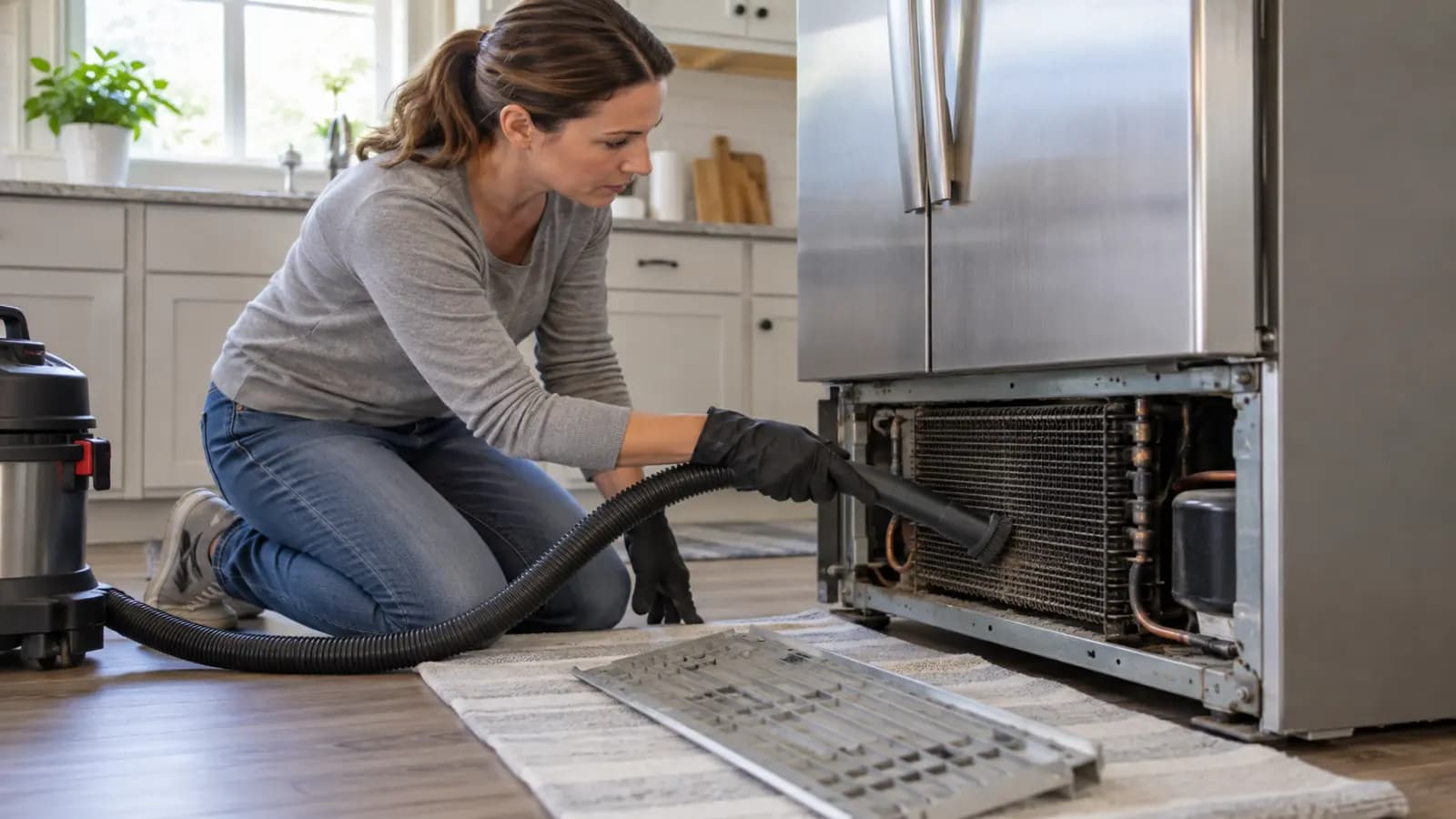
Check the installation clearance in the model manual and make sure an exposed toe grille or ventilation opening is not blocked. Condenser layout varies: coils may be exposed on the back, accessible below, or enclosed and not intended for homeowner access. Some models require cleaning; others do not. Use the manual, not a universal twice-a-year rule.
If the manual permits cleaning an accessible grille or coil, disconnect power first and use the specified soft brush or vacuum method. Protect the water line and floor, and do not move a heavy appliance alone. Stop if access requires removing a service panel, disconnecting water, reaching near sharp metal or moving parts, or straining a cord or line.
Dust can reduce heat rejection and contribute to poor performance, but cleaning it does not prove the refrigerator is repaired. Restore the unit exactly as instructed, verify the doors close, and monitor actual compartment temperature over the manufacturer's recovery period.
Minutes 16–20: observe and document—do not disassemble
With doors closed, note whether the unit is silent, runs steadily, starts and stops, hums and clicks, vibrates unusually, or has fan noise that changes when a door opens. Record a short audio or video. Do not reach toward a fan, compressor, capacitor, control board, or exposed wiring, and do not infer that one sound identifies one failed part.
Without removing a panel, note visible frost, condensation, water, and whether the freezer is colder than the refrigerator. Photograph the pattern and any model-specific error. A frost-covered interior surface can reflect a door leak, blocked airflow, defrost-system issue, or other condition; a warm fresh-food compartment with a cold freezer can have several causes. These patterns narrow a technician's tests but are not definitive diagnoses.
Check the floor and nearby cabinet for water. If an accessible shutoff can be operated safely, close the refrigerator's water supply for an active supply or dispenser leak and protect the floor. Do not assume every puddle came from the refrigerator; trace only what is visible without touching electrical components or moving the appliance unsafely.
Know what this checklist can and cannot solve
A blocked door, changed setting, demo mode, obstructed vent, or dirty owner-accessible grille may be corrected during the check. Temperature recovery is not instantaneous, so confirm the result with an appliance thermometer over the interval specified by the manufacturer while keeping food protected elsewhere.
The checklist cannot verify a start device, fan motor, sensor, damper, defrost heater, control, compressor, or sealed system. It also cannot measure refrigerant charge. A technician should test the circuit and temperature system rather than sell a part solely from a phone description.
Opening the refrigerant circuit is not a homeowner task. EPA requires Section 608 certification for technicians who service or repair equipment in a way that could release regulated refrigerant. Ask a contractor proposing sealed-system work to explain the diagnosis, refrigerant type, leak testing, recovery and charging scope, total price, and repair warranty.
Stop troubleshooting and request service when
Arrange qualified service promptly when temperatures remain unsafe after simple corrections or when the appliance presents electrical, leak, or mechanical warning signs.
Prepare a service call that produces a useful diagnosis
Before calling, collect the brand, full model and serial number, approximate age, purchase receipt, warranty or service-contract details, actual temperatures, error codes, sounds, frost or leak photos, onset time, outage history, and every step already tried. Mention whether the appliance is built-in, panel-ready, connected to water, or difficult to move.
Ask whether the diagnostic fee is credited, whether the company services that model and sealed system, and whether the first visit is diagnostic or includes stocked parts. Request a written finding that separates the confirmed failure from remaining uncertainty, then a complete price including labor, parts, shipping, refrigerant, return visits, tax, and separate parts and labor warranties.
Check manufacturer and third-party coverage before authorizing work. If the estimate is substantial, compare it with a like-for-like delivered and installed replacement—not the lowest advertised refrigerator. Include fit, door swing, water connection, cabinetry, haul-away, lead time, and food-storage disruption.
The bottom line
A safe 20-minute refrigerator check protects food first, verifies actual temperature, confirms power and model-specific controls, inspects doors and airflow, checks permitted ventilation maintenance, and documents symptoms without opening service panels. It can correct simple conditions and give a technician better evidence. It cannot safely diagnose every electrical, mechanical, or refrigerant fault.
If the refrigerator still cannot hold temperature, submit your ZIP code, brand, model, age, measured temperatures, and symptoms to request a free match with independent local appliance-repair technicians. Confirm coverage and recall status, verify qualifications for the proposed work, and obtain a written diagnosis and price before authorizing repair; there is no obligation to hire a matched provider.
Frequently asked questions
Why is my refrigerator running but not cooling?
Possible causes include changed controls, blocked airflow, an unsealed door, inadequate ventilation, frost buildup, a fan or damper problem, sensor or control faults, compressor starting trouble, or a sealed-system issue. The sound of it running does not identify the cause. Check the model-safe basics, measure temperature, and request testing if cooling does not recover.
How long is food safe when a refrigerator stops cooling?
For an unopened refrigerator during a power outage, USDA says up to four hours. A mechanical failure may have started earlier, so use measured temperature and known history. FoodSafety.gov advises discarding refrigerated perishables held above 40°F for more than two hours, or one hour when ambient temperature exceeds 90°F. Never taste food to test safety.
Should I unplug a refrigerator that is not cooling?
Unplug it for smoke, burning odor, arcing, shock, a damaged connection, or when the model manual instructs disconnection for a permitted cleaning step—only if the plug is dry and safely accessible. Do not repeatedly power-cycle it as a substitute for diagnosis. Preserve error codes first and follow the manufacturer's instructions.
Can dirty condenser coils make a refrigerator stop cooling?
Dust on a model's owner-accessible condenser area can impair heat rejection and performance, but coil design and cleaning instructions vary. Consult the exact manual, disconnect power when instructed, and never remove a service panel just to clean. Persistent unsafe temperature after permitted cleaning needs diagnosis.
Why is the freezer cold but the refrigerator warm?
The pattern suggests that cooling exists but cold air may not be reaching or remaining in the fresh-food section. Blocked vents, door leakage, frost, a fan, damper, sensor, or control issue are among the possibilities. It is not proof of one failed part, so clear visible obstructions and have unresolved cases tested.
This guide is general information, not a repair manual or a safety certification. Anything involving gas, live circuits, structural framing or standing water belongs with a licensed provider. GetLocalExperts is a free matching service and does not perform home services.
Sources and further reading
- Keep Your Food Safe During Emergencies: Power Outages, Floods & Fires — USDA Food Safety and Inspection Service
- Food Safety During Power Outage — FoodSafety.gov
- Refrigeration & Food Safety — USDA Food Safety and Inspection Service
- Not Cooling - Quad Door — Whirlpool Product Help
- Cooling Issues With Samsung Refrigerator or Freezer — Samsung Support
- Section 608 Technician Certification — U.S. Environmental Protection Agency
- Refrigerator Recalls — U.S. Consumer Product Safety Commission
This guide was researched and reviewed by the GetLocalExperts Editorial Team against primary regulatory benchmarks, state contractor licensing board standards, and FTC consumer protection guidelines.