Define the trip, labor, hardware and authorization rules before dispatch—then compare lockout, rekey and smart-lock proposals on equal scope.
Looking for verified locksmith specialists? Check availability in seconds.
Check ZIP code availabilityThere is no useful locksmith price without a defined job
A house lockout, four-cylinder rekey and smart deadbolt installation are different services. Even two lockouts differ when one has an ordinary functioning cylinder and the other has a broken key, damaged hardware or restricted key system. Time, travel area, parking, door condition and authorization constraints also change the work. A national price range cannot resolve those facts.
Build the estimate from named components: dispatch or trip charge; minimum labor; task price or hourly rate; after-hours, weekend or holiday charge; hardware and key quantities; tax or parking; and any return visit. State whether the dispatch charge is owed if no work proceeds and whether it is credited to the approved task. A low arrival price is not a total price.
For planned work, send photographs of both sides of every door, the door edge, latch or bolt, strike, keyway, manufacturer markings and any damage. For an emergency, describe the lock and door accurately without publishing keys, access codes or a full security inventory in a public message.
Handle immediate safety before shopping for a locksmith
Call 911 when a child or vulnerable person is trapped, fire or cooking creates danger, urgent medication is inaccessible, a person may be inside in distress, or another emergency exists. Move to a lit, occupied place if you feel unsafe. Do not confront a suspected intruder and do not enter after a break-in until law enforcement says the scene is safe.
If the situation is not an emergency, check lawful alternatives: another household member, building manager, landlord, roadside or homeowners assistance, a documented spare, or a functioning smart-lock method. Renters should check their lease and contact the property manager before changing or drilling hardware. Never force a window, defeat a life-safety device or attempt entry into property you are not authorized to access.
Use a written call script before dispatch
Give the address or service area, whether it is a house or multiunit property, the exact task, door and lock type, visible condition, urgency and requested arrival window. Ask the company's legal name, physical service area, callback number, technician identity, and license or registration information where applicable. Licensing is not uniform across the United States, so verify requirements with the relevant state or local agency—not a logo on an advertisement.
Request the complete pricing formula by text or email. The California Bureau of Security and Investigative Services, for example, tells consumers to verify applicable credentials and ask the dispatcher for an estimate. That is useful consumer practice nationwide, but California's particular license rules should not be presented as every state's law.
Dispatch charge, cancellation terms, labor minimum and whether the trip is credited
Price or bounded estimate for the described method, plus the trigger and rate for additional work
After-hours, mileage, parking, tax, hardware, key, programming and return-visit charges
Arrival window, technician and company identification, proof of authority required from you, and accepted payment methods
No drilling, replacement, added hardware or price change without your separate written approval
For a lockout, authorize an entry method—not just an arrival
A legitimate locksmith should establish your authority to enter. Have government identification, a lease, closing record, utility record, property manager confirmation or another reasonable combination available; the exact process depends on circumstances and local rules. If your identification is inside, say so before dispatch and agree on how authority will be confirmed after opening.
Ask for non-destructive entry to be attempted when appropriate. That is not a promise that every lock can or should be opened without damage. A failed mechanism, damaged door, certain high-security products, an engaged interior device, or evidence-preservation concern can change the method. The technician should explain the finding, consequence and revised total before drilling or replacing anything.
If drilling is proposed, ask which component will be destroyed, why a less destructive method is not suitable, what replacement is required, whether the door remains secure that day, and who owns the removed parts. Put the authorization and replacement model on the work order. An unexplained drill in the first moments is a reason to pause, not proof by itself of misconduct.
Scope a rekey by cylinder, keyway and key control
Rekeying changes a compatible cylinder so existing keys no longer operate it; it does not renew worn hardware, repair a misaligned door or automatically make unlike products accept one key. Count cylinders, not doors: a door may have separate knob and deadbolt cylinders, and cylinders can differ by keyway, format and compatibility.
Create an opening schedule with door name, hardware manufacturer or marking, cylinder count, desired access, current problem and number of new keys. State whether all exterior locks should be keyed alike, whether a household or service-access separation is needed, and whether any master-key relationship exists. Master keying creates additional key-control and security consequences and should be designed deliberately, not added casually.
After a lost or stolen key, consider what the key reveals, who may have it, whether it can be copied, and whether other doors, gates, mailboxes or shared spaces use it. Rekeying the house does not revoke a keypad code, garage remote, building credential or smart-lock account. Inventory and revoke every affected access method.
Replace hardware when the diagnosed scope requires it
Replacement may be appropriate for worn, corroded, damaged, unsupported or incompatible hardware; a failed latch or bolt; a security or accessibility upgrade; finish changes; or a move to another key system. Rekeying may be enough when compatible hardware is serviceable and only key authorization must change. Ask the locksmith to separate the security objective from the product sale.
The lock works as part of a door assembly. Document loose hinges, door sag, frame movement, weatherstrip pressure, bolt-to-strike alignment, damaged wood or metal, glass near the lock, and door-closing behavior. Do not accept a larger lock as a substitute for correcting a structural, fire-door, egress or alignment problem that lies outside its function.
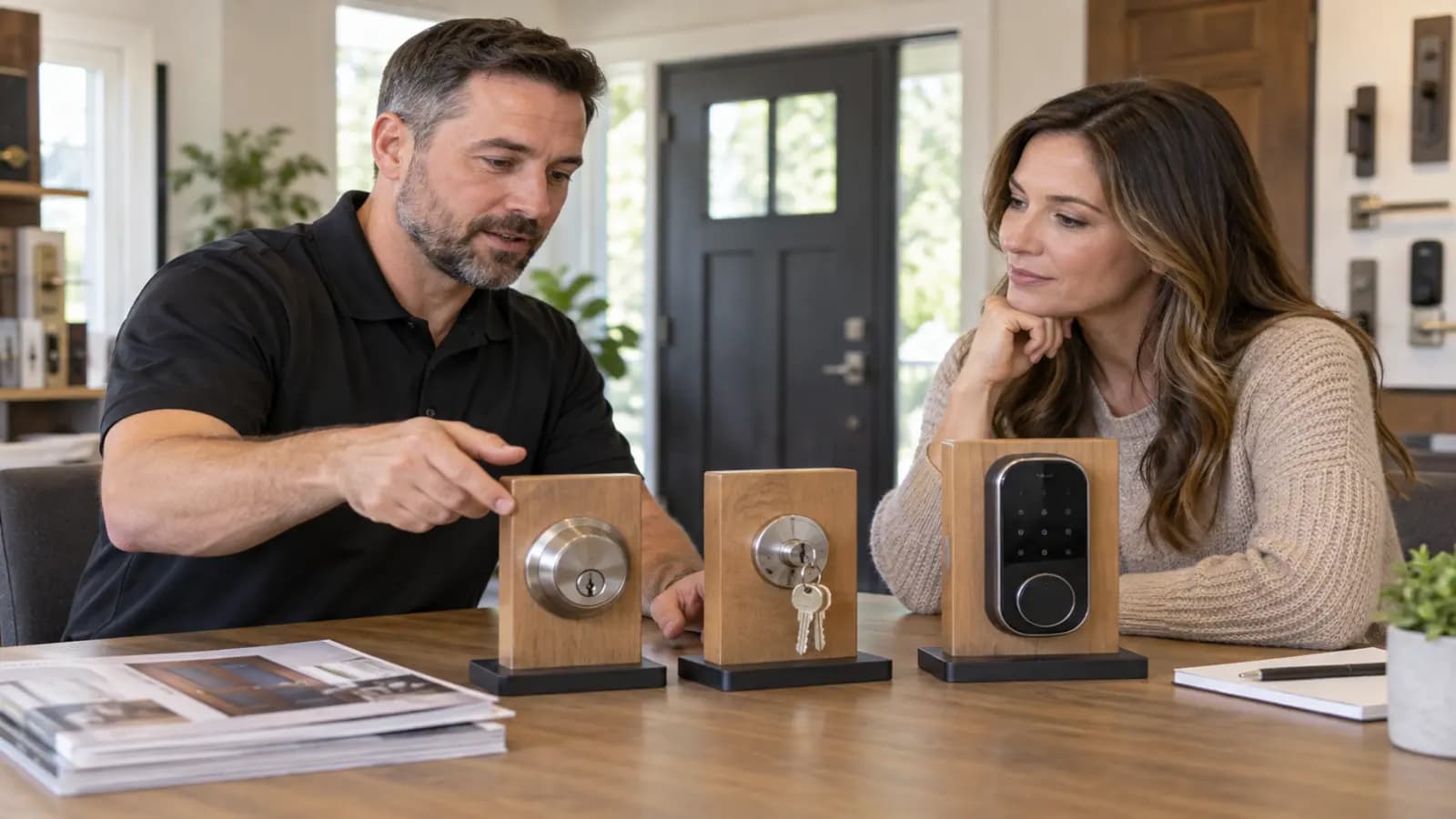
For new hardware, specify exact manufacturer, model, finish, keyway, cylinder option, certifications, included keys, warranty and return status. BHMA certification provides a way to identify products tested to applicable hardware standards; a grade or marketing label alone does not prove compatibility with your opening or guarantee the installed door assembly's performance.
Treat a smart lock as hardware, power, software and account ownership
Before purchase, verify door material and preparation, bore pattern, backset, thickness, handing, existing trim clearance, deadbolt and strike alignment, weather exposure and any required hub, bridge, Wi-Fi, Thread, Matter or home-platform compatibility. Use the exact current installation documents. A motorized bolt should not be expected to overcome a door that must be pushed or lifted to lock.
Define who supplies the lock, batteries, hub and any adapter; who modifies the door or strike; who installs, connects, updates and tests it; and whether a mechanical key or external emergency-power method exists. Confirm the manufacturer's operating environment and support period rather than assuming every connected lock is suitable for every exterior door.
At handoff, the homeowner—not the installer—should control the primary account, recovery methods and administrator permissions. Change temporary codes, remove installer access, name users, apply least privilege, enable available multifactor authentication, install current updates, record battery type and replacement procedure, and test low-battery and offline behavior. NIST identifies device configuration, data protection, access control, secure updates and cybersecurity-state awareness among relevant consumer IoT outcomes.
Compare an itemized example, not a claimed national average
The following fictional worksheet shows how scope produces a total; it is not a market estimate or recommended rate. Assume a scheduled weekday visit to inspect and rekey four compatible, serviceable exterior cylinders. The illustrative proposal lists a $75 dispatch charge, four rekeys at $45 each, four included keys, two additional keys at $8 each, and a $54 alignment adjustment on one opening: $325 before any applicable tax.
A competing $240 quote is not automatically cheaper if it covers only three cylinders, one key and no alignment. A $390 quote is not automatically worse if it includes four premium replacement cylinders instead of rekeying. Normalize quantity, products, access plan, correction work, warranty and closeout before comparing totals.
For emergency work, create the same worksheet with the described entry method, after-hours charge, destructive-entry contingency and replacement hardware. If the actual condition differs, stop, photograph it where safe, price the change and approve it in writing. Do not let urgency erase the distinction between estimate, authorization and invoice.
Control changes and payment at the door
Match the arriving technician, company identity and vehicle to the dispatch information, subject to legitimate disclosed substitutions. Ask for required credentials and confirm your written scope before tools come out. If the explanation or price has materially changed, you can pause and call the company using a number you independently verified.
Never sign a blank or incomplete work order. Record the existing condition, approved method, labor, hardware model and unit price, maximum or total, taxes and fees, warranty, and any damage risks. A change should state the newly discovered condition, recommended action, added or credited amount and effect on completion. Keep photos without exposing bitting, codes or other sensitive security details.
Pay through the agreed traceable method and obtain an itemized paid invoice. Be cautious about pressure for cash, wire transfer, cryptocurrency, gift cards or payment to a name unrelated to the company. A card dispute is not a substitute for careful authorization, and withholding an undisputed lawful charge is not a negotiating tactic. Use the regulator, attorney general, payment provider or law enforcement as appropriate if deception, threats or unauthorized work occurs.
Commission every opening before the technician leaves
Test each key from both sides where applicable, with the door open first and then closed. Confirm latch engagement, bolt extension, thumb-turn operation, strike alignment, door closing, key removal and all intended keyed-alike or separated access. Verify the door can be opened for egress as required; do not approve a security change that creates an entrapment or life-safety problem.
For a smart lock, test local keypad, phone, remote service if purchased, physical key or backup method, every authorized user role, notifications, auto-lock behavior, privacy mode, low-battery warning and operation during internet loss. Avoid deliberately exhausting batteries or creating a lockout; follow the manufacturer's documented test method.
Collect the opening schedule, new-key count, removed-key status, product packaging or model and serial records, administrator transfer confirmation, instructions, warranty contacts and paid invoice. Store access records securely. Destroy or return obsolete keys and revoke old credentials according to the agreed plan.
Use one complete locksmith quote checklist
Give each company the same facts and require each line to be included, excluded, allowed, unit-priced or identified as unknown. This makes a locksmith cost comparison useful without pretending prices are nationally uniform.
Property authority, occupant safety, landlord or manager approval, opening names, door and frame condition, lock type, cylinder count, keyway and photographs
Dispatch, minimum labor, task or hourly price, after-hours and travel charges, parking, tax, cancellation, payment method and written maximum or change process
Lockout method sequence, non-destructive attempt where appropriate, separate drilling authorization, replacement contingency, temporary security and removed-part handling
Rekey access schedule, compatibility, keyed-alike or separated groups, master-key implications, included and extra keys, old keys, other credentials and key-control record
Exact replacement or smart-lock product, door preparation, strike and alignment, certifications, power, connectivity, account transfer, codes, updates, offline test and owner training
Licensing or registration where applicable, company and technician identity, insurance requested for the scope, itemized invoice, labor and product warranties, final tests and secure records
The bottom line
The reliable way to control locksmith cost is to define the opening, task, method, timing, hardware and authorization boundary before work begins. Verify the business under your local rules, establish your authority to access the property, require a written price formula, approve drilling and changes separately, and test every mechanical and digital access path before final payment.
If you need lockout, rekey, replacement or smart-lock help, submit your ZIP code, timing, property type, number of doors and cylinders, lock photos or markings, symptoms, desired access groups, smart-home platform and landlord or manager constraints to request a free match with independent local locksmiths. Do not include keys, codes or sensitive security details. Verify applicable credentials, identity, written scope, total-price terms and warranty before hiring; there is no obligation to choose a matched provider.
Frequently asked questions
How much does a locksmith cost?
There is no dependable total without a defined task and local quote. Ask for dispatch, minimum labor, task or hourly price, timing surcharge, hardware, keys, tax, parking and return visits in writing. State whether the dispatch charge applies if you decline work and require approval before the total changes.
How much does it cost to rekey a house?
The total depends on the trip charge, number and type of cylinders, keyway compatibility, desired access groups, number of keys, hardware condition and local labor. Count cylinders rather than doors and give each bidder the same opening schedule. Separate alignment repair or replacement hardware from rekey labor.
Should I rekey or replace my locks after moving?
Rekey compatible, serviceable hardware when the main goal is revoking old keys. Replace hardware that is damaged, worn, unsupported, incompatible with the desired key system, or unsuitable for the planned security, accessibility or smart-lock function. Also revoke garage remotes, keypad codes, building credentials and digital accounts.
Can a locksmith install a smart lock?
Yes, when the provider is qualified for the specific door, hardware and connected setup. The quote should address door preparation, backset, thickness, handing, bolt alignment, power, hub or platform compatibility, account ownership, updates, codes, offline behavior, emergency access, testing and owner training.
Should a locksmith drill my lock during a lockout?
Drilling may be necessary in some conditions, but it should not be an unexplained default. Ask why a less destructive method is unsuitable, which part will be destroyed, what replacement is needed and the revised total. Give separate written authorization before drilling unless an immediate emergency lawfully dictates otherwise.
General consumer planning information, not security, legal, code, insurance, or product-specific advice. Locksmith licensing, identification, contract, payment, landlord, and access requirements vary by state and locality. Verify current local rules and product instructions.
Sources and further reading
- Consumer Guide to Locksmith Companies — California Bureau of Security and Investigative Services
- Verify a License — California Bureau of Security and Investigative Services
- Locksmith Company and Locksmith Employee Fact Sheet — California Bureau of Security and Investigative Services
- How to Avoid a Home Improvement Scam — Federal Trade Commission
- Frequently Asked Questions for Homeowners — Builders Hardware Manufacturers Association
- BHMA Certified Products Directory — Builders Hardware Manufacturers Association
- Profile of the IoT Core Baseline for Consumer IoT Products — National Institute of Standards and Technology
- User Perceptions and Experiences with Smart Home Updates — National Institute of Standards and Technology
This guide was researched and reviewed by the GetLocalExperts Editorial Team against primary regulatory benchmarks, state contractor licensing board standards, and FTC consumer protection guidelines.