Separate danger from inconvenience, move somewhere secure, check lawful access, and authorize a locksmith one decision at a time.
Looking for verified locksmith specialists? Check availability in seconds.
Check ZIP code availabilityDecide whether this is danger or inconvenience
Call 911 when there is immediate danger: a child or vulnerable person is trapped, someone inside may be injured or in medical distress, fire or smoke is present, cooking creates an urgent hazard, or you suspect an intruder. Tell the dispatcher what you know and follow instructions. Do not delay emergency help while shopping for a locksmith.
A pet inside requires judgment based on temperature, ventilation, health and distress. If imminent danger seems possible, call 911 or the local emergency service and describe the facts. For a possible poisoning, call 911 for collapse, breathing difficulty, seizure or inability to wake; otherwise US Poison Control is available at 1-800-222-1222.
If the home may have been entered unlawfully, step away and call police. Do not touch the door or ask a locksmith to open it before law enforcement addresses safety and evidence. The remaining steps assume a routine lockout without immediate danger or suspected crime.
Move to a safe waiting place
Wait in a locked vehicle, occupied neighbor's home, staffed business, building lobby or another lit location where practical. Account for traffic, severe weather, extreme temperature, wildlife and mobility. If you feel watched, threatened or followed, call 911 and move toward people rather than circling the property.
Share your location, selected company, dispatch number, arrival window and technician details with a trusted person. Preserve phone battery for calls, identification and payment. Avoid posting your address and lockout publicly, because that can announce that you are outside and the home may be unattended.
Never wait in a running vehicle inside a garage or use a grill, generator or fuel-burning heater in a home or garage. CDC warns that carbon monoxide is odorless and colorless and that fuel-burning equipment can produce it.
Check lawful access without creating another emergency
Call household members and anyone formally entrusted with a spare. Contact the landlord, manager or front desk, and check whether roadside, renters, homeowners, credit-card or membership assistance covers a house lockout. Confirm preauthorization, limits and charges before ordering service.
Use only a method you already control and are authorized to use: a building credential, garage keypad, smart-lock app, manufacturer-documented backup method or professionally installed lockbox. Do not send a stranger a key code, administrator password or complete access inventory.
Do not climb to a window or balcony, reach through broken glass, enter neighboring property, manipulate a garage release from outside or rely on online bypass tricks. Falls, cuts, entrapment, damage and unauthorized access can turn inconvenience into an emergency.
Renters and multiunit residents should call management first
A lease, building policy and local law may control after-hours entry, replacement keys, lock changes and reimbursement. Ask whether an on-call employee or approved vendor can help, what identification and fee apply, and whether management authorizes an outside locksmith. Record the responder's name and time.
Do not drill, replace or rekey common-entry hardware, a master-keyed cylinder, electronic access system or fire-rated opening without authorization. An outside change can interrupt building access and require restoration. If management cannot respond, ask in writing what temporary work is permitted and who pays.
Guests and short-term renters may need the host or booking platform; recent buyers may need a closing record or agent. Resolve verification before dispatch so a technician does not arrive unable to work while a disclosed trip charge still applies.
Do not force the door, window or lock
Breaking glass creates sharp fragments and an unsecured opening. Prying can split a jamb, distort the door and damage weather seals or a rated assembly. Cards, screwdrivers and improvised tools can injure you, damage hardware or cross legal boundaries. This guide does not provide lock-defeat instructions.
Avoid simplistic cost claims. Emergency locksmith work, glazing, doors and board-up all vary by market, timing and assembly. Safety and uncontrolled damage are the reasons not to force entry—not a guarantee that one service always costs less. During a real emergency, follow responder instructions.
If a key broke in the cylinder, stop pushing it deeper. If the door sags or the bolt is bound, stop repeatedly powering a smart lock against resistance. Tell the locksmith the symptoms and everything attempted; extraction or alignment work differs from an intact-key lockout.
Verify the locksmith before dispatch
Independently check the company's legal name, established phone number, website, service area and relevant complaints. Determine whether your state or locality regulates locksmith companies or technicians and use the regulator's own lookup. California's BSIS licenses companies and registers employees, for example, but that is not a nationwide rule.
Ask whether the caller is the service company or a dispatch marketplace, who will arrive and whether that person is an employee or subcontractor. Obtain the technician's name, callback number, vehicle description and arrival window. A legitimate substitution should be disclosed and confirmed.
The California consumer guide advises verifying applicable credentials and asking the dispatcher for an estimate. Those are sound consumer controls everywhere, while the exact credentials remain jurisdiction-specific. A local-looking phone number or map listing is not verification.
Get the complete nighttime price formula in writing
Describe the property, door, lock type, key condition and visible damage. Request a text or email listing the dispatch charge, minimum labor, price or bounded estimate for the described method, after-hours fee, mileage or parking, tax, cancellation terms and payment methods. Ask whether the trip charge applies if you decline changed work.
A low service-call figure is not the job total. Conversely, a dispatcher may not promise a fixed total for an unidentified or failed lock. A responsible answer defines assumptions, the pricing method, what could change it and the point where your approval is required.
The FTC recommends written estimates and warns against blank documents. Multiple site visits may be impractical at night, but you can compare complete phone scopes when it is safe to wait. Never sacrifice personal safety for a lower quote.
Company and technician identity, credential information where required, and arrival window
Trip, labor, nighttime, travel, parking and tax charges plus payment method
Assumed lock condition, proposed entry method and exclusions
Maximum or approval threshold if the diagnosis changes
No drilling, replacement or added hardware without separate written authorization
Prepare proof that you are authorized to enter
A responsible locksmith should not open a home merely because someone waits outside. Tell dispatch what proof you have: government identification with the address, lease, deed or closing record, utility record, manager confirmation or another reasonable combination. Requirements vary by law, policy and circumstances.
If identification is inside, arrange the process before arrival. The technician might review other records, obtain management confirmation or require ID immediately after entry. Do not ask the locksmith to ignore a mismatch or open a different unit.
Show only information reasonably needed, obscure unrelated account numbers and avoid sending full identity documents to an unverified channel. Ask how copies are handled. Proof of authority is essential, but unlimited personal-data collection is not automatically justified.
Reconfirm identity, scope and stop points on arrival
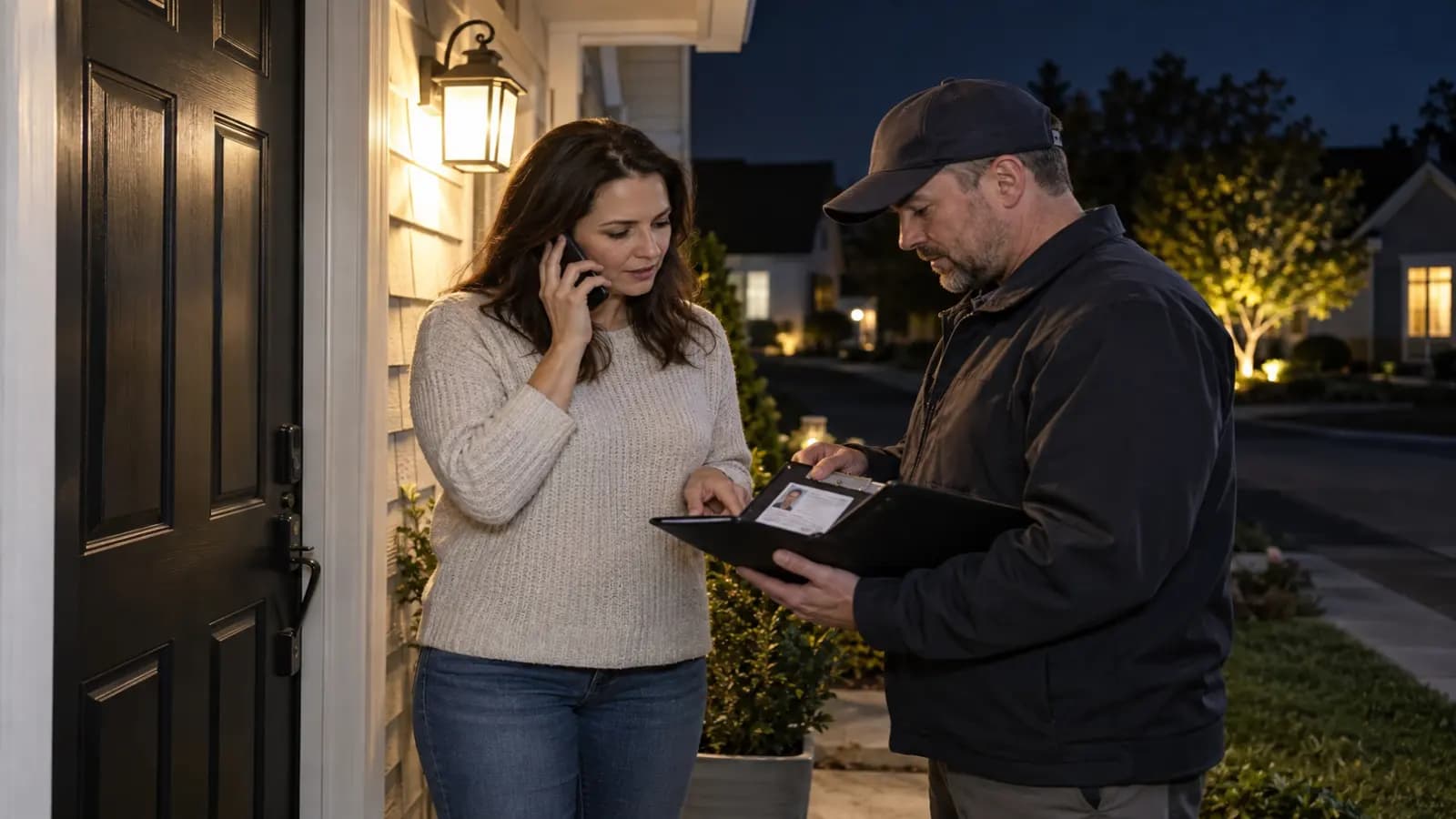
Meet in the safe agreed location and keep a trusted person informed. Match the technician and company to dispatch details, allowing substitutions only after confirmation through an independently verified number. Ask for required credentials, then provide the agreed proof of authority.
Before tools touch the lock, review a completed work order with existing condition, attempted method, trip and labor charges, nighttime fee, tax, approval limit, risks and warranty. Never sign blanks. Photograph the document and preexisting damage without revealing key or code details.
If identity, price or work materially differs from the written terms, pause and request the reason and revised total. You may decline added work subject to a lawful disclosed trip charge. If threatened or prevented from leaving, move to safety and contact police; preserve messages and paperwork.
Make drilling a separate decision
Request non-destructive entry when suitable, but do not accept a guarantee that every lock can be opened without damage. Lock design, internal failure, engaged devices, previous damage and scene conditions change the method. The technician should explain the finding.
Before drilling, ask why another method is unsuitable, which component will be destroyed, what replacement is needed, whether it is available tonight, the revised total and how the home will remain secure. Record the answers and authorization. Do not let a drilled exterior cylinder leave the property unsecured.
Fast drilling does not by itself prove fraud, and slow work does not prove competence. Informed authorization tied to a diagnosis is the control. Record the replacement manufacturer, model, key quantity and warranty and retain removed parts when appropriate.
Test entry, security and the final invoice
With the door open, test the key, thumb turn, latch and bolt; then test normal closing and strike alignment. Confirm required egress and that no temporary measure creates entrapment. Count new keys and identify which old keys should no longer work.
For a smart lock, take ownership of the administrator account, remove temporary access, change codes, and test local and documented backup entry plus expected offline behavior. Follow the manufacturer's procedure rather than deliberately causing another lockout.
Pay using the agreed traceable method and obtain an itemized paid invoice with business identity, date, address, labor, trip and after-hours charges, parts, tax and warranty. Treat demands for gift cards, cryptocurrency, wire transfer or an unrelated account as warning signs. Report suspected deception to the payment provider and appropriate regulator, attorney general, FTC or police.
Build a private, resilient lockout plan
Choose redundancy appropriate to the household: a spare with a trusted nearby person, a managed-building procedure, an appropriately placed professional lockbox, a keypad or a smart lock with documented backup access. Do not label keys with the home address or hide one in a predictable container near the entry.
For connected locks, assign individual codes, remove former users, update the device and app, use a unique owner password and available multifactor authentication, and record battery and offline-entry procedures. Store recovery data securely, not in an exposed note or shared photo album.
Keep a private contact plan with management, trusted keyholder, assistance benefit, preferred verified locksmith, proof-of-authority options and a safe meeting location. Do not record active codes, key cuts or a detailed access map on something likely to be lost with the keys.
The bottom line
When locked out at night, solve the highest-risk problem first. Call emergency services for danger or suspected crime; otherwise move somewhere secure, contact authorized keyholders or management, and check legitimate assistance. If a locksmith is needed, verify the company, agree to written charges, prepare proof of authority and establish a separate stop point before drilling, replacement or a changed price.
If it is safe to wait for a service provider, submit your ZIP code, property type, owner or renter status, door and lock description, key condition, visible damage, timing and available proof of authority to request a free match with independent local locksmiths. Do not submit codes, key details or identity records. Confirm identity, applicable credentials, written charges, entry method and warranty before hiring; there is no obligation to choose a matched provider.
Frequently asked questions
Who should I call if I am locked out of my house at night?
Call 911 for immediate danger, suspected crime, fire, or a trapped or medically vulnerable person. For a routine lockout, move somewhere safe, contact authorized household members or management, check a legitimate assistance benefit, and call an independently verified locksmith if needed.
Should I call 911 because I am locked out?
A routine lockout is generally not a 911 emergency. Call when facts indicate immediate danger, including fire, a person in distress, urgent medical need, suspected intrusion or a threat to personal safety. Explain the circumstances and follow the dispatcher's instructions.
Can a locksmith open my house if my ID is inside?
Possibly, but the locksmith should still establish your authority. Tell dispatch beforehand. The company may accept other records, obtain landlord or manager confirmation, or require identification immediately after entry. Requirements vary by jurisdiction, policy and circumstances.
How do I avoid a locksmith scam during a nighttime lockout?
Verify the company and applicable credentials independently. Get the trip, labor, nighttime fee, assumptions, payment method and change threshold in writing. Match the technician to dispatch details, never sign blanks, and authorize drilling or replacement separately.
Should a locksmith drill the lock to let me in?
Not automatically. Request a non-destructive method when suitable, while recognizing some locks or failures require drilling. Ask why alternatives are unsuitable, what will be destroyed, which replacement is needed, the revised total and how the door will remain secure.
Emergency and general consumer information only. Call 911 for immediate danger, fire, suspected crime, a trapped or medically vulnerable person, or another life-safety emergency. Do not attempt unauthorized entry. Access, landlord, licensing and contract rules vary by jurisdiction.
Sources and further reading
- Consumer Guide to Locksmith Companies — California Bureau of Security and Investigative Services
- Verify a License — California Bureau of Security and Investigative Services
- Locksmith Company and Locksmith Employee Fact Sheet — California Bureau of Security and Investigative Services
- How to Avoid a Home Improvement Scam — Federal Trade Commission
- Home Repair Scams — Federal Trade Commission
- Contact Us — America's Poison Centers
- Carbon Monoxide Poisoning Basics — Centers for Disease Control and Prevention
- Profile of the IoT Core Baseline for Consumer IoT Products — National Institute of Standards and Technology
This guide was researched and reviewed by the GetLocalExperts Editorial Team against primary regulatory benchmarks, state contractor licensing board standards, and FTC consumer protection guidelines.