Plan a home Level 2 charging project around the charging power you need, verified electrical capacity, circuit route, equipment, permits, utility programs, and finish work.
Looking for verified electrical specialists? Check availability in seconds.
Check ZIP code availabilityHome EV charger installation cost in 2026
A professionally installed home Level 2 charging project commonly costs about $800–$3,000 before major electrical-service work. A short, accessible run with adequate capacity may cost less; a long route, finished-wall fishing, outdoor pedestal, trench, detached garage, load-management system, subpanel, or service upgrade can push the project from several thousand dollars to well beyond that range. Charger hardware may be included or separate, so compare scope rather than headline totals.
Current consumer cost sources report narrower averages for simple installations, but those figures can hide the expensive part: site-specific electrical work. Treat every national figure as preliminary research. A useful local estimate follows a site assessment, charging-needs discussion, code review, and load calculation—not a photograph of two empty breaker spaces.
Budget by scope, not by one national average
These broad ranges help classify the project. They are not additive menus or quotes, and local labor, equipment, permit, code, utility, and restoration requirements can move them substantially.
Choose charging power from daily need, not the largest breaker
Start with miles driven on a demanding day, hours parked at home, vehicle efficiency, battery size, and the vehicle’s maximum AC charging rate. Many drivers can recover their normal commute overnight at 16, 24, or 32 amps and gain nothing from sizing the home around a 48-amp maximum the car cannot accept or the schedule does not need. The Department of Energy notes that many drivers can even meet daily needs with Level 1 charging when a suitable dedicated 120-volt circuit is available.
At nominal 240 volts, 16 amps is about 3.8 kilowatts, 24 amps about 5.8 kW, 32 amps about 7.7 kW, 40 amps about 9.6 kW, and 48 amps about 11.5 kW. Actual power and charging time vary with voltage, vehicle limits, temperature, battery state, and losses. Have the electrician size the circuit to the equipment nameplate, continuous-load rules, conductor method, terminal ratings, and locally adopted code.
A common continuous-load relationship means a 40-amp EVSE is supplied by a 50-amp circuit and a 48-amp EVSE by a 60-amp circuit, but homeowners should not select wire or breakers from an online chart. Installation method, conductor temperature rating, ambient conditions, bundled conductors, distance, and local amendments can change the design.
Panel slots are not electrical capacity
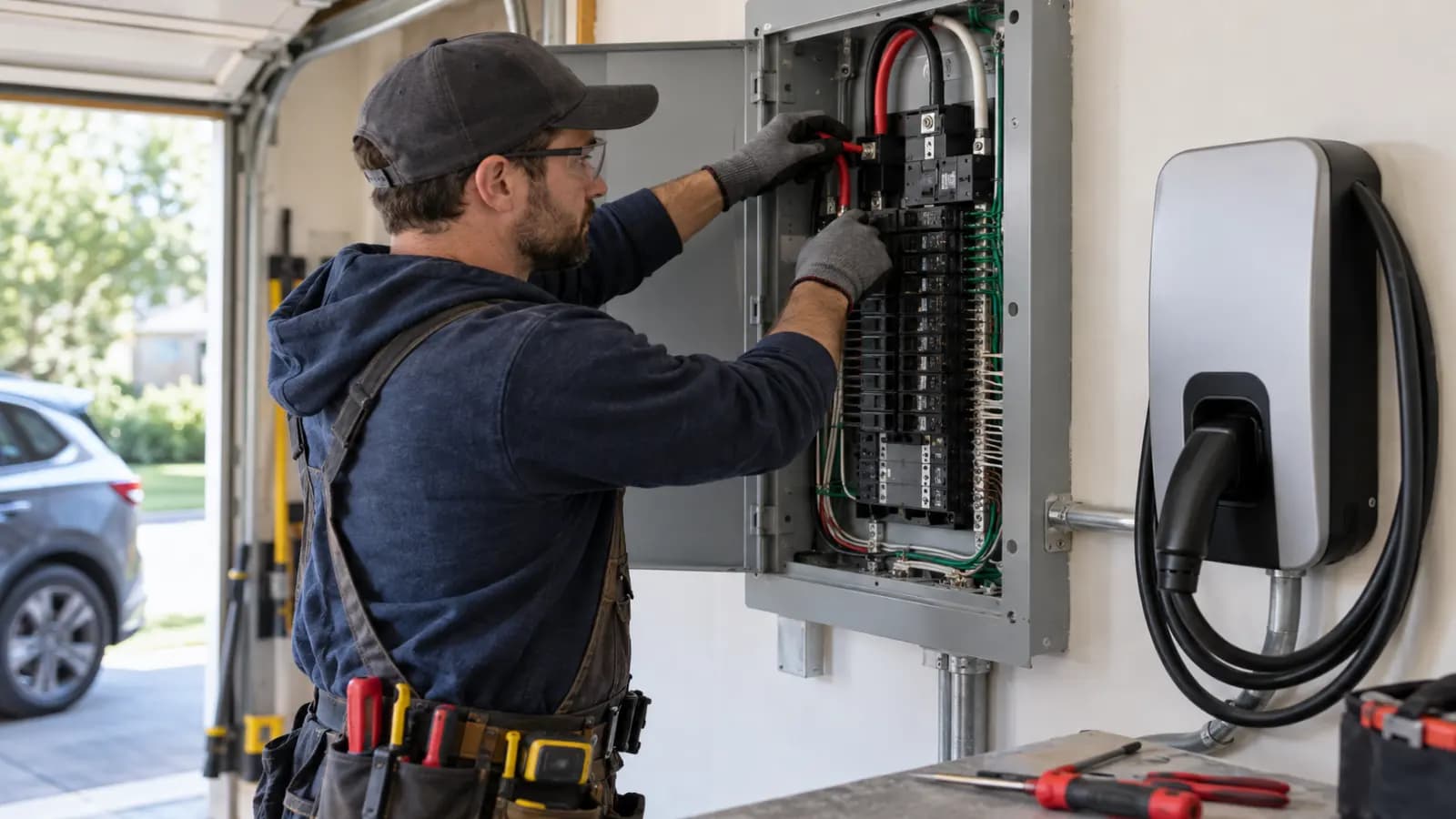
An empty two-pole space answers only whether a breaker may physically fit. The electrician must evaluate service and feeder capacity, panel and bus ratings, existing loads, equipment condition, grounding and bonding, breaker compatibility, and the applicable load calculation. A 100-amp service does not automatically fail, and a 200-amp label does not automatically pass.
Ask for the load-calculation result and the proposed EV load. If capacity is insufficient, compare code-compliant alternatives: reduce the configured charging current, use listed energy-management equipment that controls EV load, adjust the design around verified dwelling load data where allowed, add or modify a feeder or panel, or upgrade the electrical service. The correct choice depends on local code, utility rules, future electrification plans, and cost.
A service upgrade may involve more than a panel. Meter equipment, service conductors, grounding, exterior disconnects, trenching, mast or lateral work, utility engineering, transformer capacity, and code corrections can dominate the schedule and price. Require the quote to separate electrician work, utility responsibility, allowances, and restoration.
Why wire route and parking position change the price
Conductor length matters, but route difficulty often matters more. Surface conduit across an unfinished garage may be direct. Fishing through insulated finished walls, crossing an attic or crawlspace, boring masonry, firestopping, trenching, feeding a detached garage, mounting a pedestal, or avoiding other utilities adds design, labor, material, and restoration.
Place the connector where it reaches the charge port without stretching across a walkway, contacting a garage door, or requiring the vehicle to park unsafely. Consider a second future EV, a replacement vehicle with the port on another corner, cable storage, bollard protection, snow and drainage, Wi-Fi signal, direct sunlight, and accessibility. Moving the unit a few feet toward the panel may reduce cost; buying an inappropriate cable length can make the result frustrating every day.
For a detached structure, ask whether the existing feeder has capacity and whether grounding, disconnect, trench, conduit, and other structure requirements affect the scope. Do not assume a dryer outlet, extension cord, general-purpose receptacle, or unlisted splitter is a safe substitute for a designed charging installation.
Hardwired versus plug-in Level 2 charging
Hardwiring removes the receptacle-and-plug connection, supports equipment designed only for permanent connection, and may simplify some high-output or outdoor installations. It also makes removal less convenient. Plug-in EVSE can be portable and easier to replace, but it adds the cost and requirements of a suitable receptacle, enclosure, grounding arrangement, and any code-required protection.
Do not specify a receptacle only by saying “NEMA 14-50.” Ask the electrician to provide the listed device and enclosure appropriate for repeated EV charging and the location, installed to manufacturer instructions and local code. Existing receptacles should be evaluated rather than assumed suitable from shape alone. Never defeat GFCI or other required protection to stop nuisance tripping; resolve equipment and code compatibility with the electrician and manufacturer.
Equipment, connector, network, and outdoor requirements
Choose safety-certified charging equipment listed by a nationally recognized testing laboratory. ENERGY STAR says certified EV chargers meet its efficiency requirements and are safety-tested by an NRTL. Confirm compatibility with the vehicle connector or approved adapter, maximum current, adjustable-current controls, cord length, mounting, enclosure rating, operating temperature, warranty, and manufacturer support.
A networked charger may provide schedules, energy reporting, access control, demand response, or utility enrollment. Check whether core charging continues if Wi-Fi, a subscription, or the manufacturer’s cloud service is unavailable. For outdoor work, use equipment and every fitting approved for the exposure and locate it away from flood, impact, and drainage hazards according to the approved design.
Bidirectional charging or vehicle-to-home backup is not a normal Level 2 add-on. It requires a compatible vehicle, charging and transfer equipment, utility and code approval, and a coordinated system design. Price it separately from ordinary one-way charging.
Permits, inspections, utility programs, and incentives
The Department of Energy’s Alternative Fuels Data Center says charging installations must follow state and local rules and may require permits. Ask who obtains the electrical permit, whose license appears on it, which inspections are included, and whether the utility must approve new load, meter work, managed charging, or a service change. Requirements vary; confirm uncertain answers with the authority having jurisdiction.
Check utility rebates, approved-equipment lists, time-of-use rates, demand-response programs, and required preapproval before purchasing hardware. Some programs require a specific networked charger, separate meter, licensed installation, permit closeout, vehicle registration, or enrollment that affects when charging occurs.
As of August 30, 2026, the federal Section 30C credit is no longer available for residential charging property first placed in service after June 30, 2026. The IRS says eligible property placed in service from January 1, 2023 through June 30, 2026 also had location and other requirements. Do not rely on older articles advertising a current federal home-charger credit; consult the IRS or a tax professional for a prior qualifying installation.
What a complete EV charger quote should include
Give each electrician the same charger model, vehicle, desired current, parking position, and future plans. If their capacity conclusions differ, ask each to show the load calculation and explain the code-compliant design rather than comparing only totals.
Charger manufacturer, model, listing, connector, cord length, configured current, and hardware price
Circuit rating, load calculation, panel and breaker compatibility, and any managed-charging controls
Conductor material and wiring method, approximate route, conduit, trench, firestopping, and voltage-drop design
Hardwired connection or exact receptacle and enclosure specification
Indoor or outdoor mounting, pedestal, impact protection, cable management, and weather sealing
Permit, inspection, utility coordination, commissioning, app setup, and owner instruction
Drywall, paint, masonry, concrete, landscaping, and trench restoration responsibilities
Itemized alternatives for lower charging current, load management, feeder work, or service upgrade
Payment schedule, change-order process, labor warranty, equipment warranty, and closeout documents
Example: three solutions for a capacity-constrained home
Suppose a homeowner requests 48-amp charging, but the load calculation does not support an uncontrolled 48-amp load. Bid A upgrades the service and preserves maximum charging plus capacity for future electrification. Bid B installs approved energy management that limits or pauses charging when household demand is high. Bid C configures a smaller circuit that still replaces the homeowner’s typical daily driving overnight.
None is automatically best. Compare total installed cost, utility timeline, charging hours, future heat-pump or induction plans, equipment dependence, warranty, and what happens if the charger is replaced. The useful electrician presents the assumptions and tradeoffs instead of treating the most expensive electrical upgrade as the only legitimate answer—or promising that software can solve capacity without an approved design.
The bottom line
The right EV charger installation is sized to the driver and vehicle, proven by a load calculation, routed for the real parking space, permitted when required, and documented as a complete electrical system. A larger amperage number is not automatically better, and an empty breaker space is not evidence of capacity.
If you need a home charging assessment, submit your ZIP code and project details to request a free match with independent local electricians. Verify licensing, insurance, equipment listing, permit responsibility, and the written design before hiring; there is no obligation to choose a matched provider.
Frequently asked questions
How much does it cost to install a Level 2 charger at home?
A common 2026 planning range is about $800–$3,000 for a professionally installed residential Level 2 project. A short run may cost less, while trenching, detached garages, load management, subpanels, service upgrades, premium hardware, or finish restoration can cost substantially more. Confirm whether hardware and permits are included.
Do I need a 200-amp panel for an EV charger?
Not automatically. Service size, panel condition, existing loads, charging current, and the applicable load calculation determine the answer. Some 100-amp homes can support appropriately sized or managed charging, while some 200-amp homes may still need design changes. Have a qualified electrician document the calculation.
Is a hardwired EV charger better than a NEMA 14-50 outlet?
Hardwiring removes one connection point and may suit higher-output or outdoor equipment; a plug-in unit can be easier to move or replace. The best option depends on equipment instructions, local code, required protection, location, current, and homeowner priorities. Both require a properly designed installation.
Can load management avoid an electrical service upgrade?
Sometimes. Listed energy-management equipment can control EV charging based on available capacity when designed and approved for the installation. Lower configured charging current may also work. Compare these options with service work using a load calculation, local code, utility rules, daily charging needs, and future electrical plans.
Is there still a federal tax credit for a home EV charger in 2026?
Not for qualifying property first placed in service after June 30, 2026 under the current IRS guidance. Installations placed in service from January 1, 2023 through June 30, 2026 had geographic and other eligibility rules. Check current IRS instructions and consult a tax professional for your specific filing.
Cost ranges here are general research estimates compiled from national and regional data. They are not quotes, offers or price guarantees — only a licensed provider who has seen the job can price it. GetLocalExperts is a free matching service and does not perform home services.
Sources and further reading
- Charging Electric Vehicles at Home — U.S. Department of Energy Alternative Fuels Data Center
- Electric Vehicle Chargers: Buying Guidance — ENERGY STAR
- EVSE Key Product Criteria — ENERGY STAR
- Alternative Fuel Vehicle Refueling Property Credit — Internal Revenue Service
- Eligible Census Tract FAQs for the Section 30C Credit — Internal Revenue Service
- EV Charger Installation Cost in 2026 — EnergySage
- Electric Vehicle Charging Installation Costs [2026] — Angi
This guide was researched and reviewed by the GetLocalExperts Editorial Team against primary regulatory benchmarks, state contractor licensing board standards, and FTC consumer protection guidelines.